Starting in early 2026, investors in several of the largest non-traded private credit funds asked to withdraw and received only part of what they requested. The remainder rolled to a later quarter, with no promise it would clear then. An investor who had counted on that cash for a tax payment or a property closing had to find the money somewhere else.
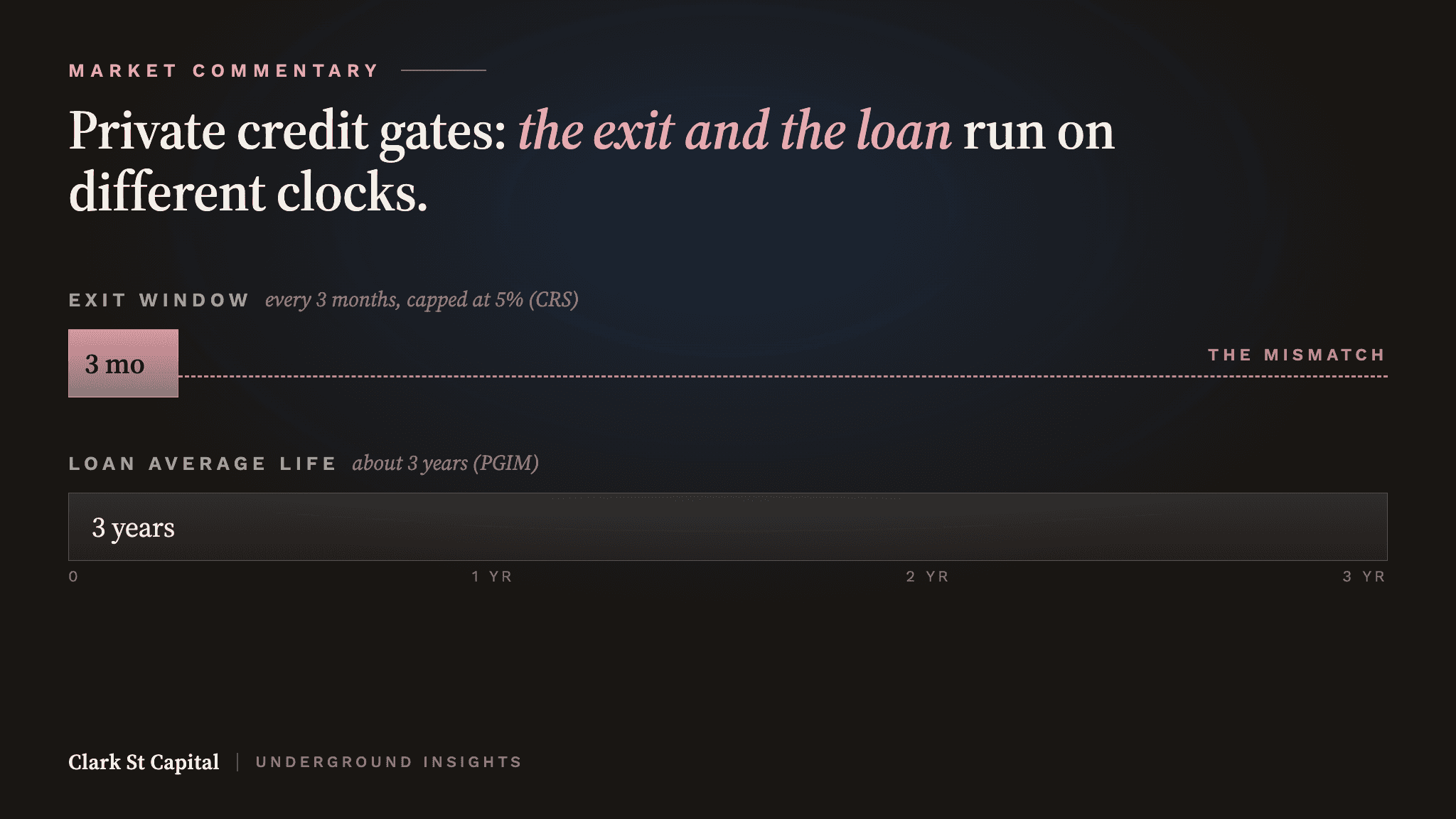
Private credit funds gated redemptions because they offered quarterly exits, typically capped near 5% of net assets, while holding loans that take about three years to repay. When withdrawal requests outran loan payoffs, funds enforced the caps. The test for any credit fund is how its worst-case exit compares to the date the money is needed.
What happened with private credit redemptions?
Most non-traded private credit funds let investors sell shares back to the fund once a quarter, up to a cap. The Congressional Research Service says that cap typically sits around 5% of the fund's net asset value per quarter.
In early 2026, requests ran well past it. CRS tracked funds where quarterly requests reached 7.9%, 11.2% and as high as 41% of the fund. Some funds paid out anyway. Others enforced the cap and left the rest of the requests for a later quarter. One stopped quarterly redemptions altogether.
It didn't end there. In the second quarter investors asked for $15.6 billion back and requests topped the 5% cap at 10 of the 16 business development companies that Fitch tracks. By the third quarter Apollo Debt Solutions had capped withdrawals at 5% three quarters running, most recently after requests of 14.7%. Not every fund was hit. Goldman Sachs' private credit fund received requests of about 2% in the third quarter and paid all of them.
The main trigger was software. CRS estimates private credit funds had around $500 billion of exposure to software-as-a-service companies as of December 2025 and AI coding tools cut into those companies' revenue.
A redemption gate is a limit, written into the fund documents, on how much investors can withdraw in a given period. Past the limit, everyone else waits.
Why do funds gate?
A fund can only hand back cash it has. PGIM puts the average life of direct loans at around three years and calls the mismatch between those loans and semi-liquid funds "plain to see." When exit requests outrun the cash coming in from payoffs, the gate comes down.
Hypothetical example: a fund has $1 billion in net assets and a 5% quarterly cap, so it will buy back $50 million this quarter. Requests total $100 million. If the fund fills requests pro rata, an investor who asked for $100,000 gets $50,000 now. The other $50,000 waits for next quarter, when the line may be just as long.
Borrowing adds pressure. CRS notes that some funds rely on bank funding and a lender to the fund gets paid before its investors. CRS also describes "run-like behavior." Early redeemers get cashed out at the reported value, so investors who suspect that value is stale have a reason to leave first.
PGIM notes that managers generally disclosed the 5% quarterly threshold up front. Its view is that trading liquidity for a higher return can be worthwhile over time, provided investors are warned of the terms before they invest.
Is all private credit the same risk?
No. "Private credit" means lending done outside a bank and CRS defines the core of it as loans to small and medium-sized private companies, a market of nearly $2 trillion in the U.S. The 2026 gates came from that corporate lending.
What sits under the loan decides the risk. A loan to a software company is backed by the company's cash flow. If revenue shrinks, so does the thing securing the loan. A loan secured by real estate is backed by a property that can be appraised and sold. For the basics of the real estate side, see real estate private credit, explained.
The fund's structure matters as much as the loans. The SEC says interval funds generally offer to buy back 5% to 25% of shares every three, six or twelve months and that oversubscribed requests are generally filled pro rata. Other funds, often called term or closed-end funds, lock capital up for a set period and pay out as loans repay. Some business development companies list on a stock exchange, where shares sell any trading day at whatever price the market sets.
Where private credit fits in your financial journey
CRS notes that investors with long time horizons may benefit from the extra return that illiquid lending pays and the 2026 redemption wave suggests some investors didn't fully appreciate what illiquid meant.
Private credit tends to suit you if:
- You want income more than growth from this slice of your money.
- You can leave the money alone for the fund's full worst-case exit period, with no plan that depends on it.
- You already hold enough cash and easily sold investments to cover emergencies and near-term goals.
Keep money in something you can sell daily if:
- You'll need it for a house, tuition, a business or taxes within the fund's exit window.
- You'd want out in a downturn. Gates tighten exactly when many investors want out at once.
- It's your emergency reserve, in any amount.
To decide for a specific fund, run three steps:
- Write down the date you'll need the money.
- Find the fund's worst-case exit. For a semi-liquid fund, assume the gate holds for several quarters in a row. For a term fund, assume a loan runs past its due date and your exit waits for it.
- Compare the two. If the worst-case exit lands after your need date, the fund fits your timeline. If it lands before, the fund doesn't fit this money, however good the yield looks.
Questions to ask any private credit fund
- How often can you exit and what is the cap per window?
- What is the average life of the loans and how does it compare to the exit window?
- When requests exceed the cap, are they filled pro rata or in order received? Does an unfilled request carry forward, or do you resubmit?
- What notice period applies and is there a fee for an early exit? The SEC notes some interval funds deduct a fee from repurchase proceeds.
- Does the fund borrow and who gets paid first if cash gets tight?
- What secures the loans and in what lien position?
- How is the fund's value set and how often are the loans revalued?
For the rest of the scorecard, see how to compare real estate debt funds and what a real estate debt fund is.
Frequently asked questions
What is a private credit fund redemption?
A redemption is when an investor sells shares back to the fund for cash. Most non-traded private credit funds allow it once a quarter, up to a cap that CRS says typically sits around 5% of net asset value.
Is private credit a bubble?
CRS sizes the U.S. market at nearly $2 trillion, a fraction of the more than $120 trillion U.S. capital markets. The 2026 stress centered on corporate loans to software companies. CRS doesn't forecast where the market goes. For an investor, the question that matters is whether a specific fund's exit terms fit a specific need date.
Can you get your money out of a gated fund?
Usually in stages. A fund that keeps paying up to its cap returns money over several windows instead of all at once. A fund can also suspend redemptions, as one did in 2026. The fund documents set the order and timing.
About Ed Mathews
Ed is the President of Clark St Capital. He started investing in 2011 after analyzing deal after deal and making zero offers, until a mentor handed him a pen and made him sign his first contract. Since then, Clark St has operated across single-family, multifamily and land development, with Ed also invested as a limited partner in funds and large multifamily projects. Ed also spent more than two decades in Silicon Valley building systems for global companies. He hosts the Real Estate Underground podcast, with new episodes every Tuesday at 12pm.