Real estate private credit is a plain idea wearing an intimidating name. It's money lent against real estate, secured by the property, earning income from the interest the borrower pays. That's the whole thing.
For most of its life it was an institutional game. Blackstone. Oaktree. Pension funds and endowments. If you were an individual with a good income and some savings, the door was closed to you.
That door is open now. Accredited individuals can sit in the same seat the big institutions have occupied for decades. Before you walk through it, you should understand what you're actually buying, and how to tell a trustworthy version from a black box.
TL;DR
- Real estate private credit means lending against property instead of owning it. You earn income from the borrower's interest, secured by a lien on the building.
- It grew because banks pulled back from a lot of real estate lending after 2008, and private lenders stepped into the gap.
- Individuals can now access it because the rules changed. A Reg D 506(c) offering lets a fund raise from accredited investors directly.
- The risk isn't the category. It's the structure. A giant fund can be a black box where you never see what backs your money.
- The version worth your capital is one you can trace: first-position loans, a real equity cushion under each one, and a manager you can actually get on the phone.
What real estate private credit actually is
Strip the jargon and there are only two seats in any real estate deal. You can own the property, or you can lend against it.
Private credit is the lending seat. Instead of buying a building and betting on its value going up, you loan money to the person who buys it. They pay you interest. Your loan is secured by the property itself, which means if the borrower can't pay, there's a real asset standing behind your money.
"Private" just means the loan doesn't come from a bank and doesn't trade on a public exchange. It's a direct arrangement between a lender and a borrower. "Credit" is a fancy word for debt. Put them together and you get a category that sounds exclusive but describes something ordinary: private parties lending money against real estate.
The reason it matters to you is the seat you're in. The lender gets paid before the owner sees a dime. When you own the equity, you eat the first loss. When you hold the debt, you're first in line to get paid and last to get hurt.
Why it grew into one of the biggest stories in finance
For decades, banks did most of the real estate lending. Then 2008 happened.
After the financial crisis, regulators tightened the rules on what banks could lend against. Capital requirements went up. Appetite for anything that looked risky went down. Banks retreated from whole categories of real estate lending, especially the smaller, faster, value-add deals that don't fit a rigid underwriting box.
That retreat left a gap. Borrowers still needed money. Good projects still needed funding. And someone had to fill it.
Private lenders did. What used to be a corner of Wall Street became one of the fastest-growing parts of finance, because the demand was real and the banks had walked away from it. Higher interest rates over the last few years only made the lending seat more attractive. You could earn a solid return on a loan secured by a hard asset, without betting on prices climbing.
That's the honest reason "private credit" is suddenly everywhere in the financial press. It isn't a fad. It's the market routing around a gap the banks left open.
Ed unpacked this exact shift with a lender on Real Estate Underground, including why the smaller Connecticut deals banks won't touch are often the safest to fund. Episode link below.
Why individuals can finally get in
Here's the part that changed the game for you personally.
For most of the last century, private offerings couldn't be advertised. If you didn't already know the right people, you never heard about the deal. That kept private credit locked inside institutions and a small circle of connected investors.
The rules loosened. A Reg D 506(c) offering now lets a fund raise capital from accredited investors and talk about it openly, as long as every investor's accredited status is verified. Accredited means an income above 200,000 dollars, or a net worth above one million dollars outside your home.
That single change is why a doctor, an attorney, or a business owner can now access a category that used to be reserved for pension funds. The seat opened up. But an open door is not the same as a safe room. Which brings us to the part that actually matters.
The black box problem
Not all private credit is built the same, and this is where individuals get hurt.
A giant fund can be a black box. Your money goes into a pool. That pool lends to other funds, which lend to other borrowers, across hundreds of loans in markets you'll never visit. There are layers of managers between you and the actual property, each taking a fee. You get a target return and a quarterly statement, and you're asked to trust that the machine works.
Maybe it does. But you can't see it. You can't name the buildings your money is lent against. You can't tell me the equity cushion under any single loan. When something goes wrong three layers down, you find out last.
The category didn't fail those investors. The structure did. Scale and distance are the enemy of knowing what you own.
What a transparent version looks like
Now picture the opposite.
A focused fund lends against real estate in one market, run by an operator who has flipped houses in that market for years and knows exactly what backs every loan. You can see the property. You can see that the loan sits in first position. You can see the borrower's own equity sitting underneath yours, first in line to absorb a loss.
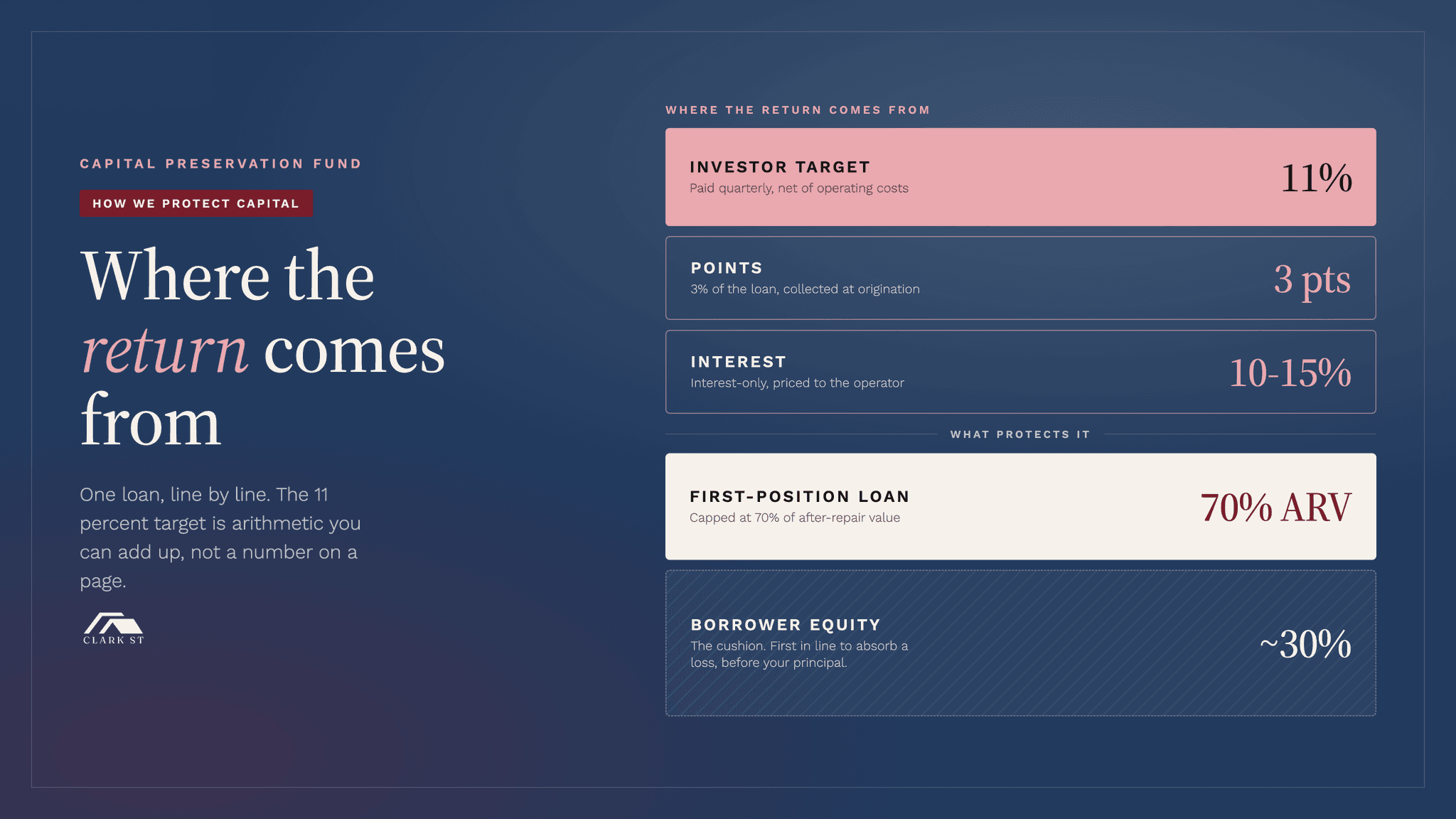
That's the version worth your capital. At Clark St, we lend in first position and cap every loan at 70 percent of a property's finished value, so the borrower's roughly 30 percent equity cushions your principal before it's ever at risk. The target return is 11 percent, paid quarterly, and we call it a target because it is one, not a guarantee. We invest our own money alongside yours on the same terms. The minimum is 100,000 dollars, and it's open to accredited investors only.
You don't have to invest with us to use the test. Apply it to any private credit fund you're handed. Can you see what backs your money? Can you trace the return to something real? Can you get the manager on the phone? If the answer is no, the yield on the brochure doesn't matter.
The takeaway
Real estate private credit isn't complicated, and it isn't a fad. It's the lending seat in a real estate deal, opened up to individuals by a change in the rules.
The category is sound. The question is always the structure. A black box asks you to trust a machine you can't see. A transparent fund lets you trace every dollar to a specific property, a specific lien, and a specific cushion beneath it.
The next time the financial press throws "private credit" at you, you'll know what they mean, and you'll know the one question that separates the trustworthy versions from the rest.
If you want the operator's read on how these loans behave through a real cycle, told through actual deals instead of projections, that's what our newsletter, Underground Insights, covers every month. It isn't tips and tricks. It's real deals and the real lessons of putting capital to work and protecting it.
Sign up at clarkst.com/newsletter.
Prefer to listen? Subscribe to the Real Estate Underground podcast for the same conversations, unscripted.
About Ed Mathews
Ed is the founder of Clark St Capital, Clark St Homes and Elevista. He started investing in 2011 after analyzing deal after deal and making zero offers, until a mentor handed him a pen and made him sign his first contract. Since then, Clark St has operated across single-family, multifamily and land development, with Ed also invested as a limited partner in funds and large multifamily projects. Ed also spent more than two decades in Silicon Valley building systems for global companies. He hosts the Real Estate Underground podcast, with new episodes every Tuesday at 12pm.