A skeptical investor sat across the table from me last week and asked me a question. It's one of the most important questions an investor can ask, probably second only to "how do I get my money back?"
He asked, "where does the 11 percent actually come from?"
Good. That's the right question. Every yield that ever blew up sounded great. However, few, if any, laid out their math.
So here's the math. A real estate debt fund earns its return from the borrower payments: interest on the loan, points at origination and in a worst case scenario, a first-position claim on the property that gets paid before anyone else. The target return isn't magic. It's arithmetic you can follow.
TL;DR
- A target you can't trace is a number on a page. Here's the arithmetic under it.
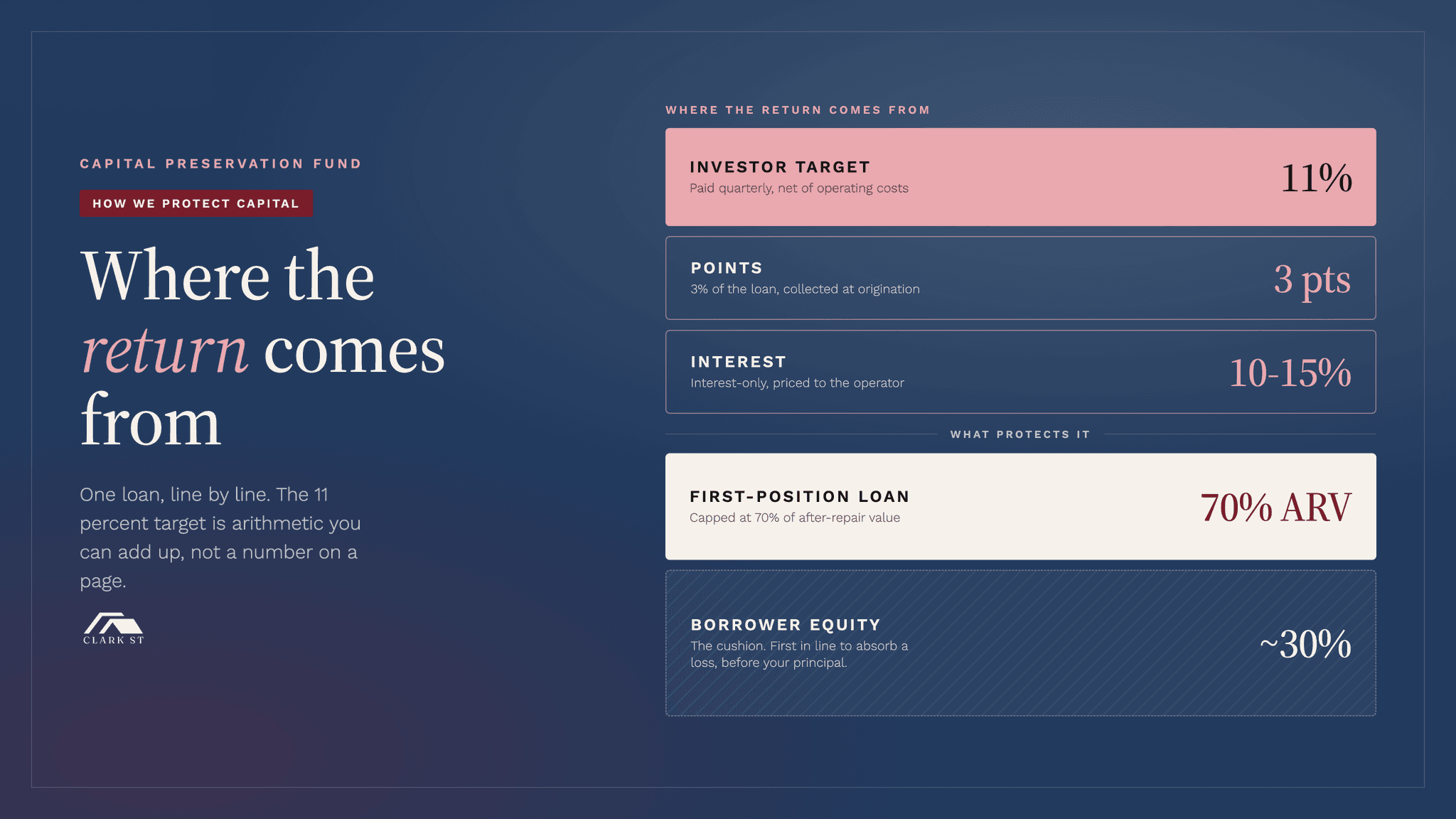
- The money comes from the borrower: interest paid on the loan (10 to 15 percent, interest-only) plus 3 points at origination.
- We cap every loan at 70 percent of the property's after-repair value, so the borrower's roughly 30 percent equity sits under us, first in line to absorb a loss. We lend in first position on top of that cushion.
- We don't chase yield on a weak borrower. The rate is priced to the operator and the project and we cap how much we'll lend against the finished value.
- The 11 percent is a target, not a guarantee, because operating costs are real and they vary. There's no promote skimmed off the top. We invest alongside you on the same terms, paid quarterly.
Where the money actually comes from
Strip away the brochure language and a debt strategy has two revenue lines. Both come out of the borrower's pocket, not out of a market that has to cooperate.
The first is interest. The borrower pays between 10 and 15 percent annualized, interest-only, on the money we lend. That rate isn't arbitrary. A vetted operator with a long track record and strong financials borrows near the bottom of that band. A newer operator, or a riskier project, prices near the top. The rate is set by who's borrowing and what they're building.
The second is points. The borrower pays 3 points at origination, which is 3 percent of the loan, paid up front the day it closes. That's real income to the fund on day one, before a single interest payment lands. This money is used to pay the costs of operating a loan, i.e. lawyers, accountants, transaction coordinators etc.
Take one loan. We lend a vetted operator at 12 percent, interest-only, plus 3 points. That loan is throwing off yield well north of the 11 percent target before we account for anything else. The interest and the points are the engine. Everything after this is about protecting that engine and being transparent about what lands in your account.
What sits under the loan when a deal goes sideways
Income is only half the story. The other half is what happens when a borrower gets in trouble, because, unfortunately, some of them will.
We lend in first position. That means if the project falls short of projections and the property sells, we get paid before anyone else with a claim on it.
And we cap the loan at 70 percent of the property's after-repair value. So the borrower puts in roughly 30 percent of the finished value as their own equity and that money sits underneath ours. It's first in line to absorb a loss. The property has to fall through the borrower's entire 30 percent cushion before it ever touches your principal.
There's a second layer of protection most lenders skip. At closing, we hold six months of the borrower's interest in escrow, an interest reserve. If an operator hits a rough patch mid-project, those payments keep coming to you while we work the problem with them. You're not waiting on a stressed borrower to stay current using their savings. The reserve does the lifting.
Why we won't chase the highest yield
Here's the part that should make a conservative investor lean in. We turn down yield on purpose.
The fattest yields usually come from the shakiest borrowers. That's a trap. A newer operator on a thin deal will pay the top of the band and reaching for that rate is exactly how debt funds blow up.
So we hold two lines. We lend only to vetted, experienced operators and we cap the loan at 70 percent of the finished value no matter how much yield the deal projects.
That's the whole ball game in debt deals. The return has to come from a borrower who can actually finish the project and a cushion that protects you if they can't, not from stretching for the highest rate on the table.
Why 11 percent is a target and never a guarantee
Now the most important part, the part the pitches skip.
The 11 percent is a target. It is not a guarantee and anyone who tells you a debt fund's return is guaranteed is telling you something that isn't true, and financially dangerous.
Here's why the words "target" vs "guarantee" matter.
What reaches you is the interest and points the loans earn, minus the actual cost of running the fund. Those operating costs are real and they move. In a typical year they're low and the number lands where we want it. In a year with a workout or two, they can cost more. That variability is exactly why it's a target you can follow rather than a promise we can't keep.
One more thing, because it's the part that hopefully earns your trust.
There's no promote and no spread skimmed off the top for the manager. We don't take a cut of your return before you see it.
Clark St invests alongside our investors in the same fund on the same terms, so our money is exposed to the same loans yours are in. When we underwrite conservatively, we're protecting our own capital right next to yours.
Distributions are paid quarterly, on a 12-month fund term.
That's the machine. Interest and points from the borrower, a first-position claim cushioned by the borrower's 30 percent equity, a reserve that keeps you paid through trouble and a target we're honest enough to call a target.
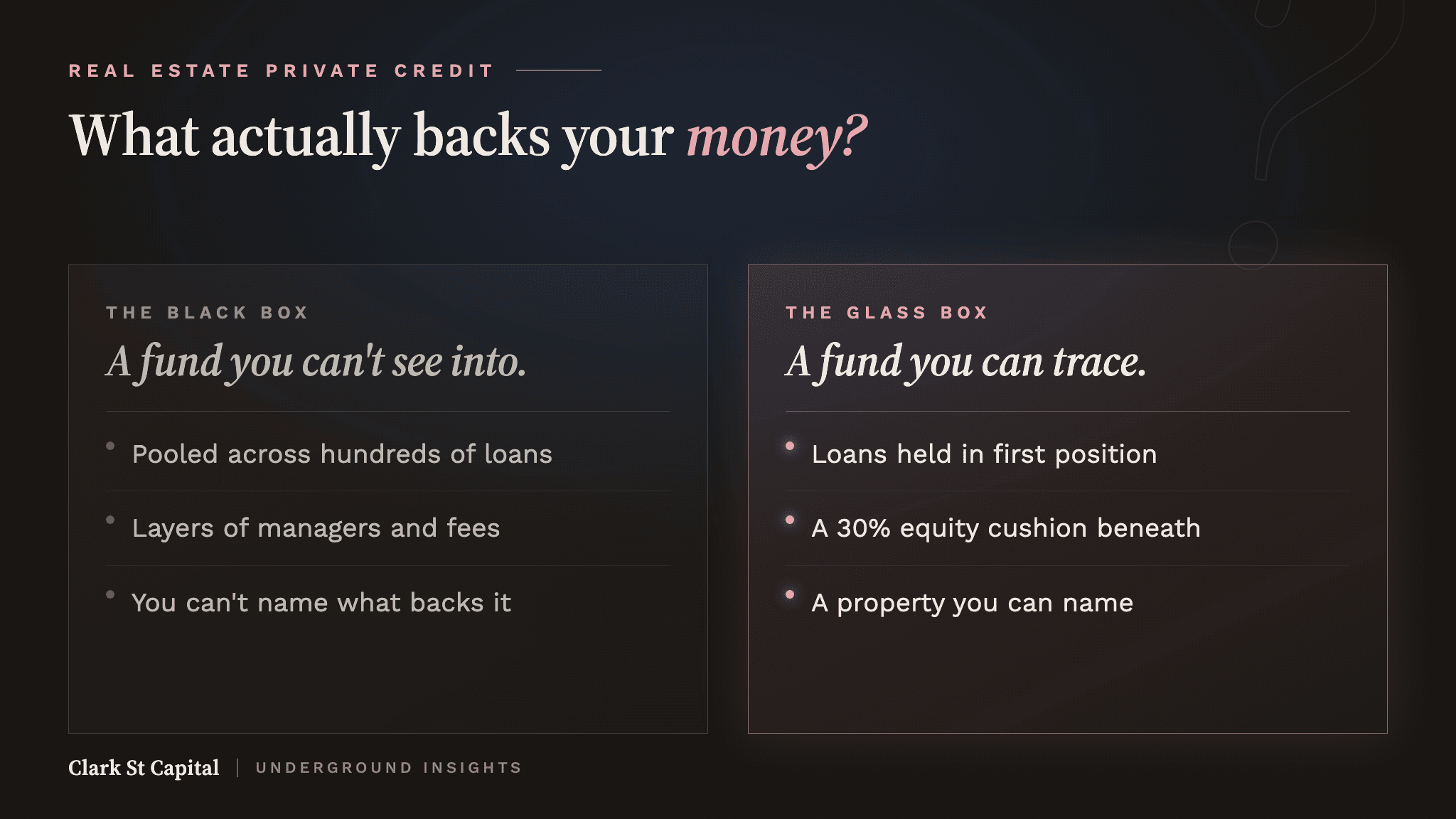
No black box. Just clear, easy to understand math.
The takeaway
If you can't trace a return, don't trust it.
That's the right instinct and it's the one this strategy is built to satisfy. The 11 percent target isn't a headline we're asking you to believe. It's a sum you can add up: what the borrower pays, minus what it costs to run the fund, protected by the equity sitting under every loan.
If you want the operator's read on how these loans behave through a real cycle, told through actual deals instead of projections, that's what our newsletter, Underground Insights, covers every month. It isn't tips and tricks. It's real deals and the real lessons of putting capital to work and protecting it.
Sign up at clarkst.com/newsletter.
Ready to see the fund itself? The Capital Preservation Fund is open now. You can review the offering at clarkst.com/invest.
Prefer to listen? Subscribe to the Real Estate Underground podcast for the same conversations, unscripted.
About Ed Mathews
Ed is the founder of Clark St Capital, Clark St Homes and Elevista. He started investing in 2011 after analyzing deal after deal and making zero offers, until a mentor handed him a pen and made him sign his first contract. Since then, Clark St has operated across single-family, multifamily and land development, with Ed also invested as a limited partner in funds and large multifamily projects. Ed also spent more than two decades in Silicon Valley building systems for global companies. He hosts the Real Estate Underground podcast, with new episodes every Tuesday at 12pm.