An investor called me a few weeks ago with three debt fund pitches spread across his desk. One advertised 9 percent. One said 12. One said 14. He asked me the obvious question. Which one do I pick?
Wrong question. He was doing what almost everyone does with a stack of funds. He lined them up by yield and let the biggest number win.
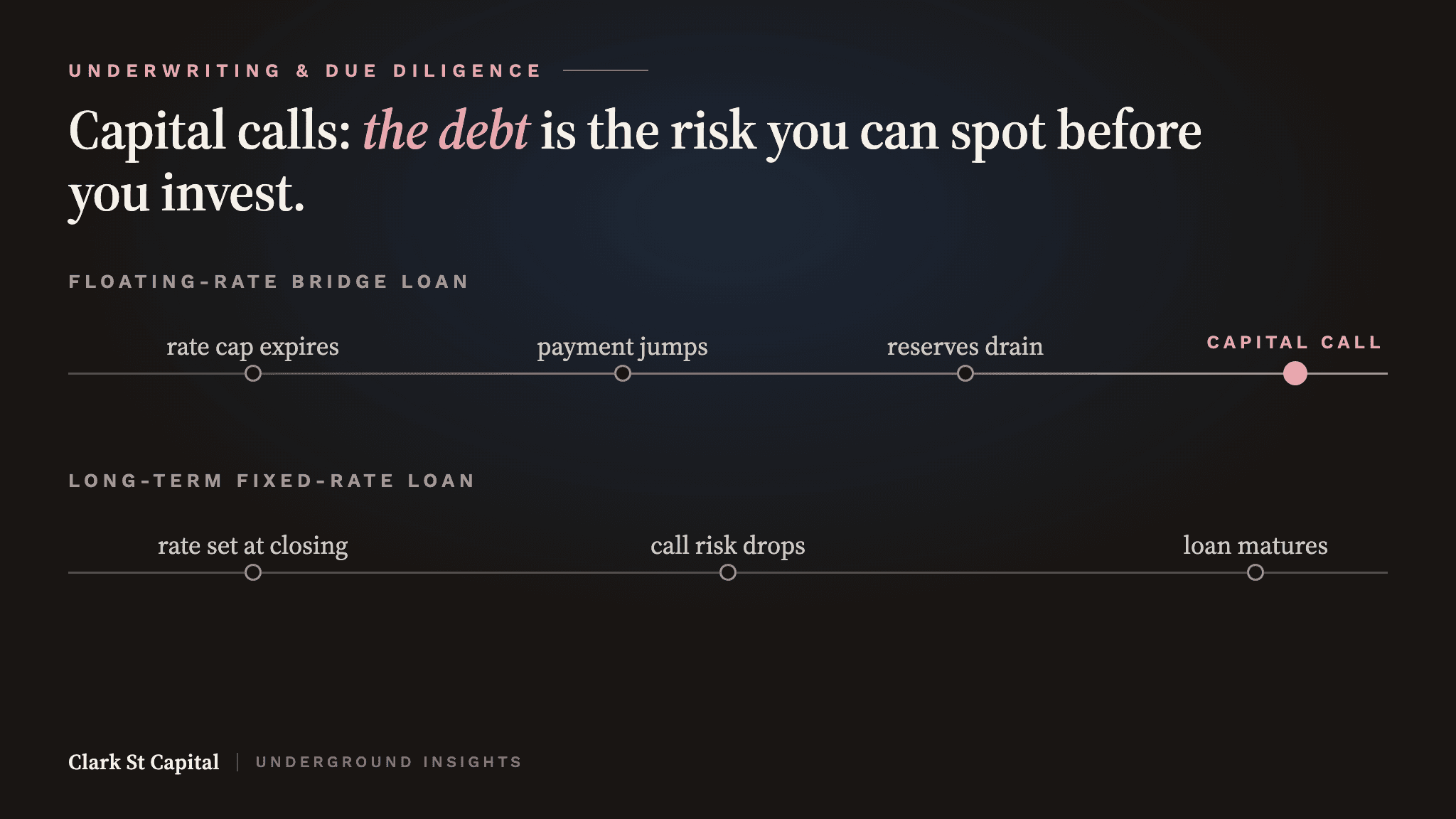
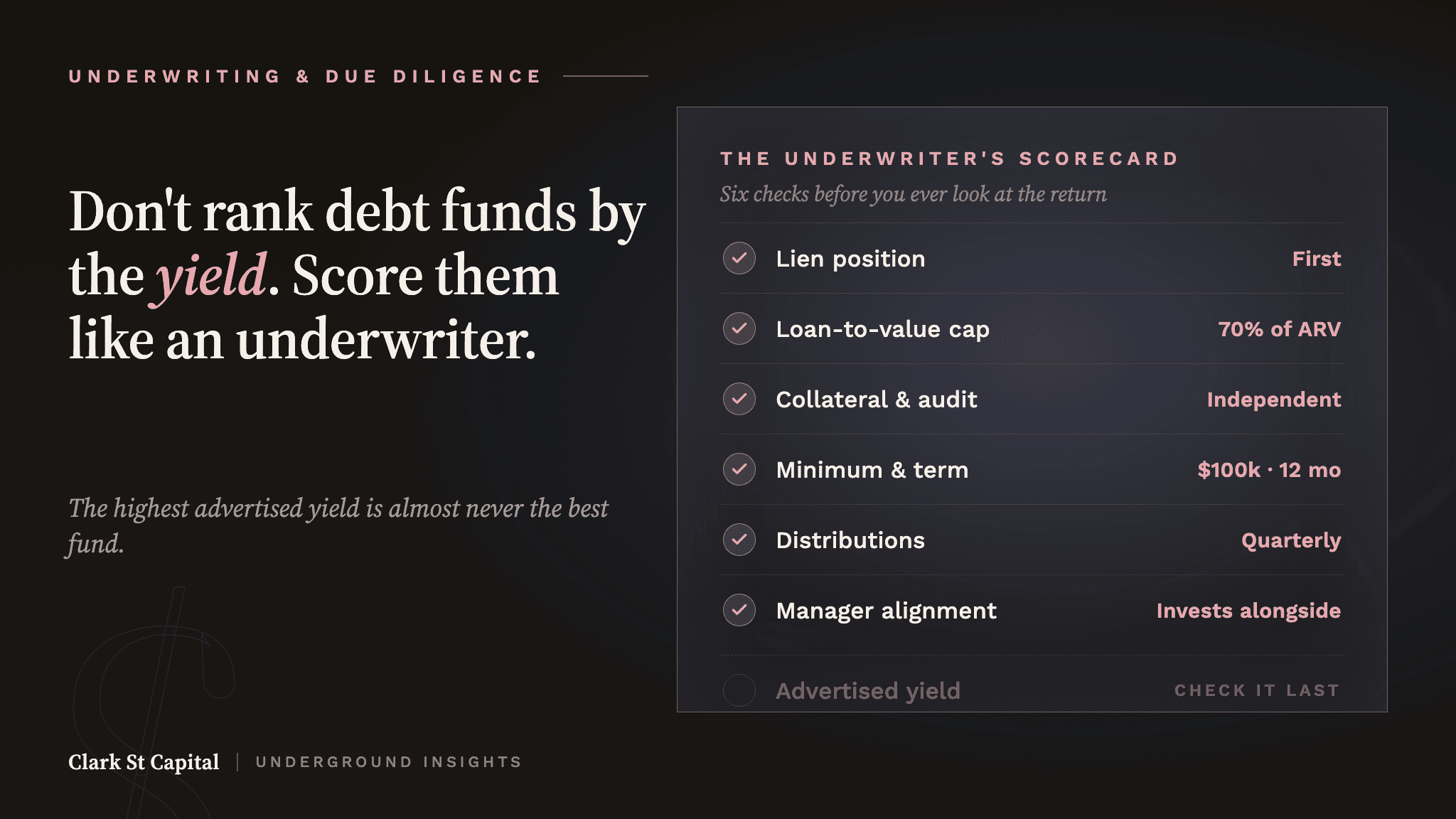
The highest advertised yield is almost never the best fund. Usually it's the opposite. A 14 percent target sitting next to a 9 percent target isn't a better deal. It's a louder one, and the extra points are almost always paying you for risk the pitch didn't mention. The way to compare funds isn't to rank the yields. It's to score each fund the way an underwriter scores a loan, and look at the yield last.
TL;DR
- Yield is the output, not the input. It's the last number in a chain, and every link before it is where the risk lives. Score the risk first.
- Lien position decides who gets paid when a property sells. First position is the conservative seat. Second position and mezzanine pay more because you stand further back in line.
- Loan-to-value is the cushion. A fund capped at 70 percent of after-repair value keeps the owner's roughly 30 percent equity underneath your loan to absorb the first loss.
- Who holds the collateral and who audits the books separates a real fund from a story. Ask for the fund administrator's name and the auditor's.
- The terms decide your liquidity: a 100,000 dollar minimum, a 12-month term, and quarterly distributions behave nothing like a five-year lockup with a redemption gate.
- Alignment beats a point of yield. A manager with their own money in the fund, no promote and no spread, makes different decisions when a deal gets stressed.
Yield is the output, not the input
When you compare funds by their advertised return, you're grading the answer without checking the work. Yield is what a fund reports at the end. It's the last number in a long chain, and every link before it is where the risk actually sits.
An underwriter never starts with the yield. She starts with the collateral and works forward. You should too. Score the six things below first, and let the yield be the last thing you look at, not the first.
Where do you sit in line?
The first question on any loan is who gets paid first. Same for a fund.
If the fund lends in first position, its loans are first in line when a property sells. A borrower defaults, the property gets sold, and a first-position lender is made whole before anyone junior sees a dollar. A fund holding second-position or mezzanine paper sits behind a bank. It only gets paid if there's money left after the senior lender is satisfied.
That back-of-the-line seat pays a higher rate for a reason. You're being paid to stand further from the money. Ask exactly where the fund's loans sit. First position is the conservative seat. Everything else is a yield-for-risk trade the pitch may not spell out.
A first-position lien gets paid before any junior claim when a property is sold. A fund advertising a fatter yield off second-position or mezzanine loans is paying you for standing further back in line, not for being a better manager.
How much will they lend against the property?
A high yield built on thin equity is a trap. The number that protects you isn't the interest rate the borrower pays. It's how much the fund is willing to lend against the finished value of the property.
We cap every loan at 70 percent of a property's after-repair value. That means the borrower's roughly 30 percent equity sits underneath the loan and takes the first loss. The property has to fall through that entire cushion before it ever touches investor principal. A fund lending at 85 percent of value is running a much thinner cushion, and it will quietly show up as a slightly higher yield.
The strongest funds add a second layer on top of the cushion. At closing they hold six months of the borrower's interest in escrow, so distributions keep landing while they work out a stressed deal instead of waiting on a borrower to stay current from savings.
Two questions cut through the pitch. What's the loan-to-value cap? And is it measured against the purchase price or the after-repair value, because those are very different numbers. The cushion is the whole game.
Ed walks through what actually happens when a property sells for less than the loan on the Real Estate Underground podcast, told through real deals instead of projections.
Who holds the paper, and who checks the books?
Two questions separate a real fund from a good story.
First, who actually holds the collateral? The fund should be the named lender on a recorded first-position mortgage, not a buyer of participations in someone else's loans where a third party controls the paper. If the fund doesn't hold the lien directly, you're a step removed from the asset you think is backing you.
Second, who administers the fund? An independent, third-party administrator keeps the books, verifies the assets, and produces statements the manager can't quietly edit. A fund that self-administers and self-reports is asking you to trust its own math. Ask for the administrator's name. Ask whether the fund is audited and by whom. If the answers are vague, that's your answer.
The terms that decide when you get your money
Now the mechanics that decide how your capital actually behaves.
The minimum to invest in this kind of fund is 100,000 dollars, and it's for accredited investors. The term matters as much as the rate. A 12-month term is a very different commitment than a five-year lockup, and a fund that pays quarterly puts cash in your account four times a year instead of asking you to wait on a distant exit.
Read the liquidity terms before you read the yield. When can you get your principal back? What's the notice period? Is there a gate that lets the manager freeze redemptions in a bad quarter? A high target return wrapped in a five-year lockup with a redemption gate is a different product than a quarterly-paying, 12-month position, even when the headline numbers look close.
Does the manager have skin in the game?
Last, the person running it. Two funds can hold identical paper and behave nothing alike, because one manager invests alongside you and the other collects a fee no matter how your capital does.
Ask two things. What has the manager actually returned to investors, realized and not projected? And how does the manager get paid? A promote or a spread skimmed off the top before you see your distribution means the manager wins whether or not you do.
When the manager puts their own money in the same fund on the same terms, with no promote and no spread, their capital is exposed to the same loans yours is. That alignment is worth more than a point of yield, because it changes every decision the manager makes when a deal gets stressed. The manager protecting their own principal is protecting yours in the same move.
Score the fund, then look at the yield
Go back to the three pitches on the desk. Score them on lien position, loan-to-value cap, who holds the collateral, who audits the books, the terms, and the manager's alignment, and the yields stop looking like a ranking.
The 14 percent fund was lending in second position at 85 percent of value with a five-year lockup. The 9 percent fund was first position, capped at 70 percent of after-repair value, paid quarterly, with the manager's own money in it and a target of 11 percent that it called a target, never a guarantee. The higher headline number was paying for risk, not skill.
That's the underwriter's habit worth stealing. The yield is the last thing you check, because by the time you get to it, the scorecard has already told you which fund is actually safe.
You've got the scorecard now. If you want the operator's read on how these funds behave through a real cycle, told through actual deals instead of projections, that's what our newsletter, Underground Insights, covers every month. It isn't tips and tricks. It's real deals and the real lessons of putting capital to work and protecting it.
Sign up at clarkst.com/newsletter.
Ready to run the scorecard on a real one? The Capital Preservation Fund is open now. You can review the offering at clarkst.com/invest.
Prefer to listen? Subscribe to the Real Estate Underground podcast for the same conversations, unscripted.
About Ed Mathews
Ed is the founder of Clark St Capital, Clark St Homes and Elevista. He started investing in 2011 after analyzing deal after deal and making zero offers, until a mentor handed him a pen and made him sign his first contract. Since then, Clark St has operated across single-family, multifamily and land development, with Ed also invested as a limited partner in funds and large multifamily projects. Ed also spent more than two decades in Silicon Valley building systems for global companies. He hosts the Real Estate Underground podcast, with new episodes every Tuesday at 12pm.