An investor showed me two deals last month. Both were pitched to him as passive commercial real estate. One was an equity stake in a 200-unit apartment complex. The other was a spot in a fund that lends against smaller properties. Same three words on the cover. He assumed they carried the same risk.
They don't. They sit on opposite ends of it.
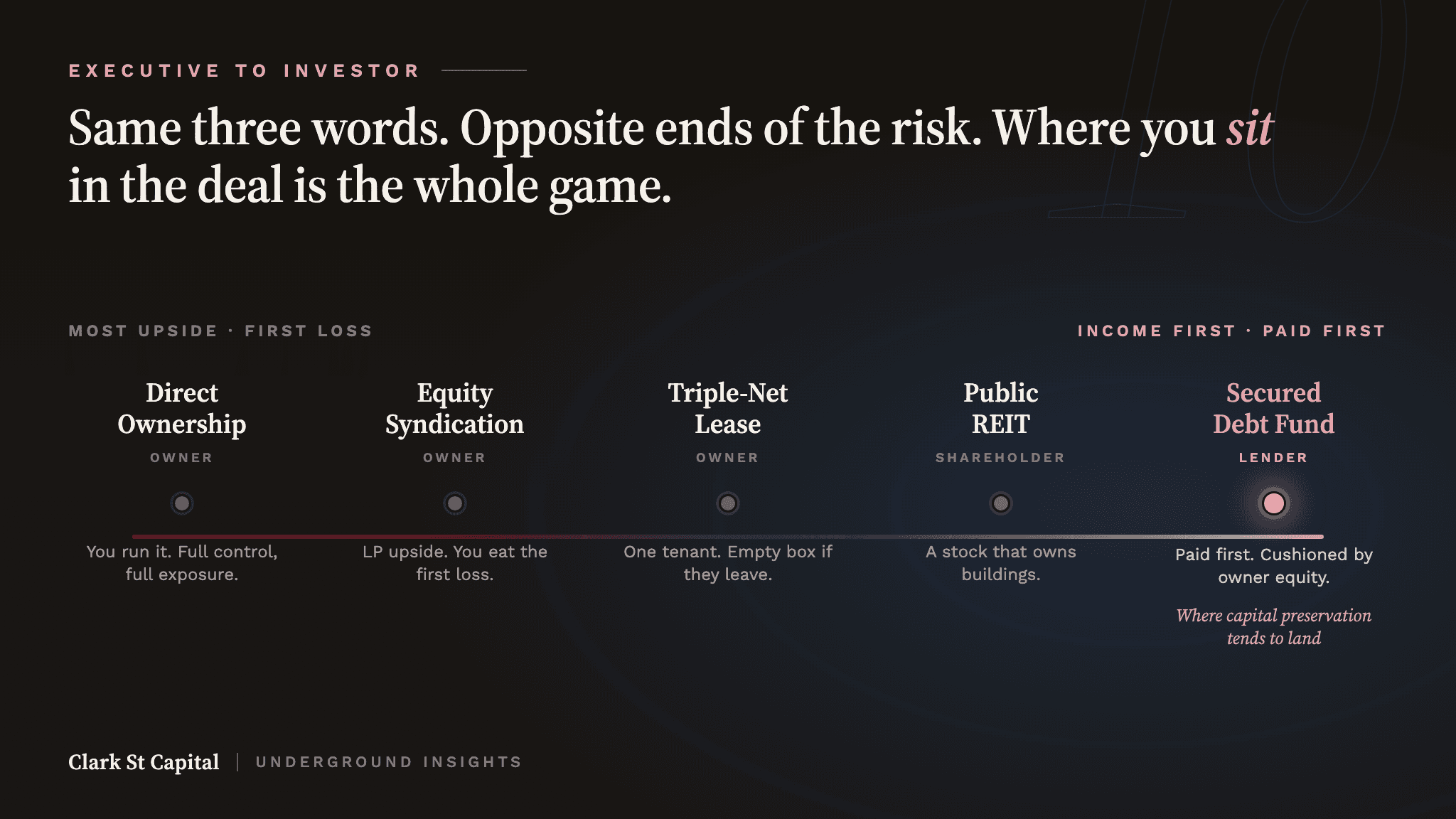
Passive commercial real estate investing is not one thing. It's a spectrum. On one end you own the property and eat the first loss for a shot at the biggest upside. On the other end you lend against the property and get paid first, trading upside for protection. Everything gets sold under the same friendly label. Where you land on that spectrum decides how much of your money is actually at risk.
TL;DR
- "Passive" only tells you that you're not swinging the hammer. It says nothing about risk.
- Every commercial real estate deal has a capital stack. Equity sits on top: most upside, first to absorb a loss. Debt sits at the bottom: paid first, last to lose.
- The same three words get stapled to big multifamily equity, triple-net deals, public REITs, and debt funds. They are not the same bet.
- A capital-preservation investor usually wants the lender's seat: income first, first-position claim, an equity cushion beneath the loan.
- Our own fund targets 11 percent, paid quarterly, in first position, capped at 70 percent of a property's finished value. That's a target, not a guarantee.
What "passive" is actually hiding
Passive means you're not the one managing tenants or chasing contractors. That's it. It's a statement about your calendar, not about your risk.
Two investments can both be passive and land in completely different places. One can pay you a steady check every quarter. The other can hand you a capital call in a bad year and ask for more money to save the deal. Both were sold as passive commercial real estate. The word did none of the work of telling you which was which.
So stop reading "passive" as "safe." Read it as "someone else operates it." Then go find out where you sit in the deal.
Where you sit in the deal is the whole game
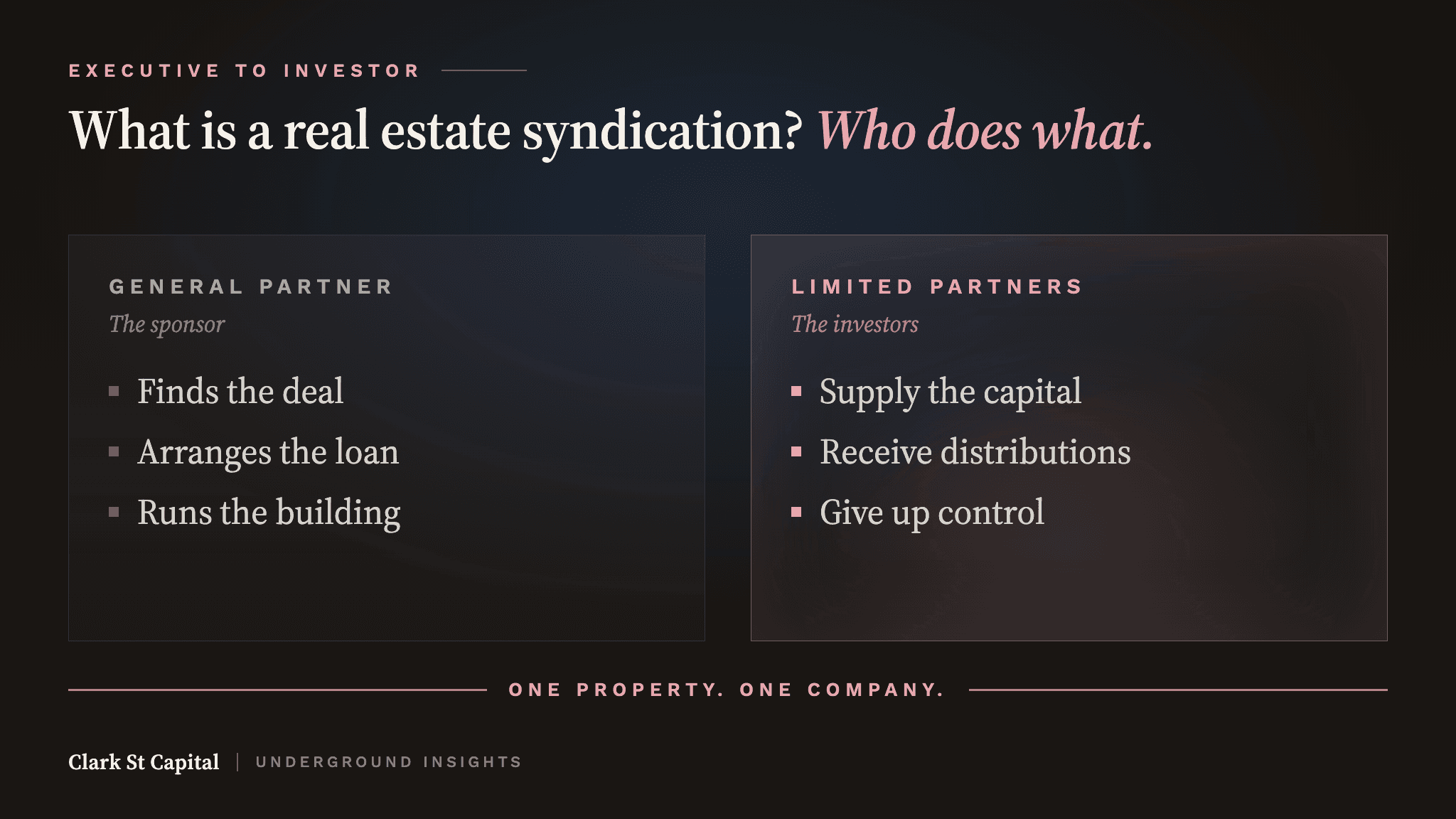
Every commercial property is bought with a stack of money. At the bottom is the debt, the loan against the property. On top of that is the equity, the owner's money.
That order is not decoration. It's the order you get paid, and the order you lose.
The equity on top gets the upside. If the property doubles, the owners keep most of that gain. But if the deal goes sideways and the property sells for less than expected, the equity is first in line to absorb the loss. It gets wiped out before the debt loses a dollar.
The debt at the bottom is the opposite trade. It gets paid first, before the owners see anything. Its return is capped at the interest rate. It gives up the home-run upside in exchange for being last to lose. The whole equity layer above it has to be gone before the lender takes a scratch.
"Passive commercial real estate" tells you none of this. Whether you're buying the top of that stack or the bottom is the single most important thing about the investment, and it's the thing the label hides.
Ed walked through this exact stack with a guest on the Real Estate Underground podcast, using a deal that went the wrong way.
The versions being sold, walked end to end
Here's the same spectrum in the products you'll actually get pitched.
Direct ownership with a manager. You buy the building and hire someone to run it. This is the least passive of the passive options and the most exposed. Full control, full upside, and you eat every problem the property has.
Equity syndication. You're a limited partner in a bigger deal, often a large multifamily project. This is where most of the 18 to 20 percent pitches live. Real upside if it works. But you're buying the top of the stack, and the last three years taught a lot of LPs what the first-loss seat feels like when rates move and the business plan stalls.
Triple-net lease. One tenant, a long lease, a check that shows up like clockwork. Genuinely passive income, until the single tenant leaves and you own an empty box with a mortgage on it. The risk didn't disappear. It concentrated into one signature.
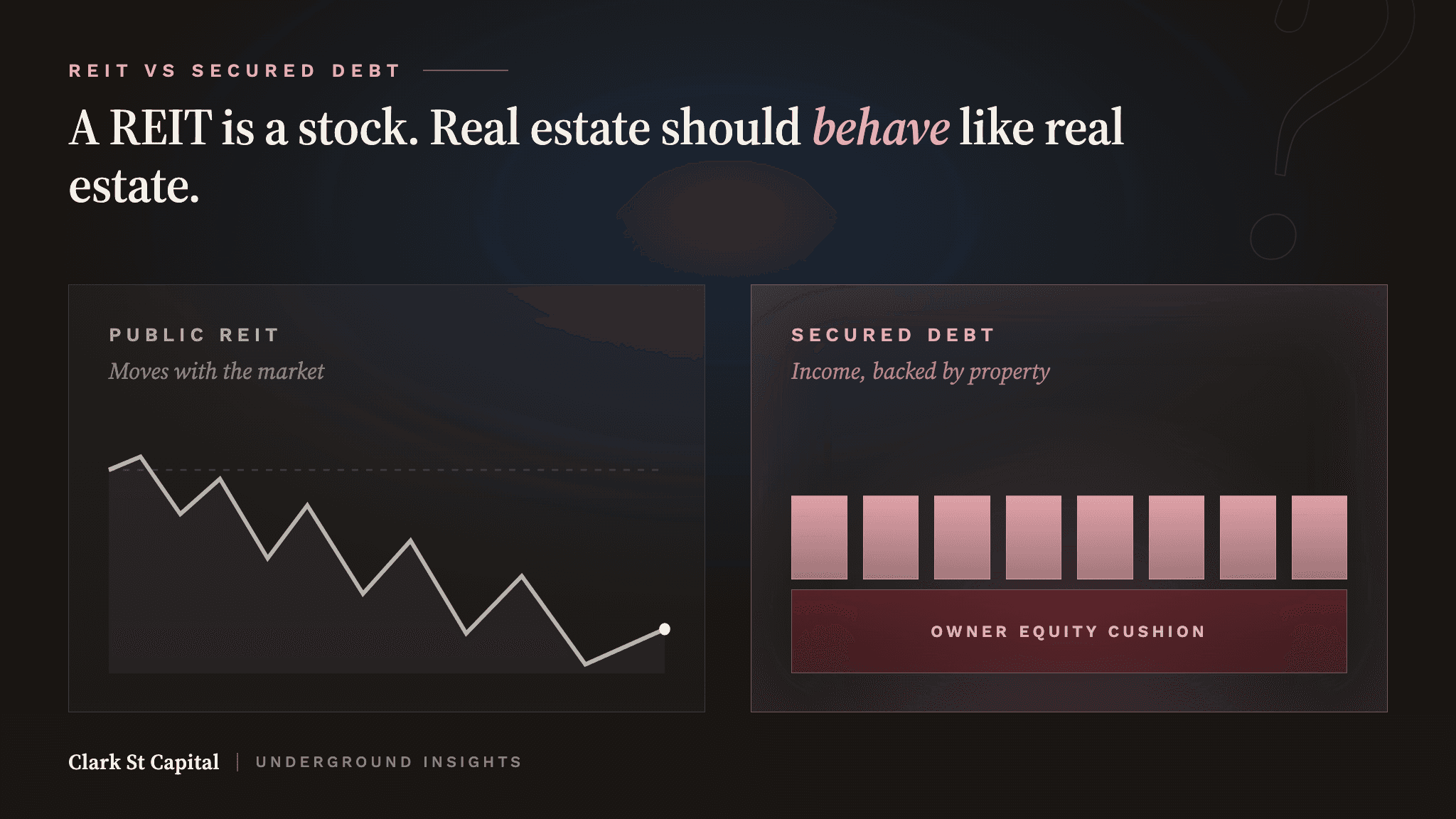
Public REIT. Easy to buy, liquid, and technically real estate. But a REIT is a stock that owns buildings, and it trades like a stock. If you bought it to diversify away from your portfolio, it tends to fall right when your portfolio does.
Secured real estate debt fund. A private real estate fund that lends against properties instead of owning them. You're at the bottom of the stack. Income first, upside capped, and an equity cushion sitting between you and a loss. This is the lender's seat.
Where a capital-preservation investor tends to land
If your goal is to protect capital and compound a steady return, you usually don't want the top of the stack. You want the bottom.
That's the seat our own fund is built around. We lend in first position, which means we get paid before the owners on any property we lend against. We cap every loan at 70 percent of the property's after-repair value, so the borrower's roughly 30 percent equity sits underneath us and absorbs the first loss before our principal is ever touched.
The target is 11 percent, paid quarterly, on a 12-month term, with a 100,000 dollar minimum. It's a target, not a guarantee, because the actual cost of running the fund varies year to year, and we won't promise a number we don't fully control. What you give up is the home run. What you get is a return you can trace and a cushion under it.
That's the honest read on the whole spectrum. "Passive commercial real estate" isn't a strategy. It's a label wrapped around a dozen different bets. Before you wire a dollar, find out one thing: are you buying the seat that gets the upside and the first loss, or the seat that gets paid first and loses last?
The takeaway
Passive tells you who runs the property. It doesn't tell you where you stand if the property struggles.
The muddy term clears up the second you ask where you sit in the capital stack. Top of the stack is upside and first loss. Bottom is income and protection. Neither is wrong. But they are not the same investment, and no investor should confuse the two because they were sold with the same three words.
If you want the operator's read on how these deals actually behave through a cycle, told through real deals instead of projections, that's what our newsletter, Underground Insights, covers every month. It isn't tips and tricks. It's real deals and the real lessons of putting capital to work and protecting it.
Sign up at clarkst.com/newsletter.
Prefer to listen? Subscribe to the Real Estate Underground podcast for the same conversations, unscripted.
About Ed Mathews
Ed is the founder of Clark St Capital, Clark St Homes and Elevista. He started investing in 2011 after analyzing deal after deal and making zero offers, until a mentor handed him a pen and made him sign his first contract. Since then, Clark St has operated across single-family, multifamily and land development, with Ed also invested as a limited partner in funds and large multifamily projects. Ed also spent more than two decades in Silicon Valley building systems for global companies. He hosts the Real Estate Underground podcast, with new episodes every Tuesday at 12pm.