You have the income. You've been told for years real estate is a smart way to diversify. And you've done nothing, because the only version you can picture is tenants, toilets and an 11pm call about a broken furnace.
Here's the thing. That's not the only way in. Residential is only one asset class in an enormous field full of opportunities.
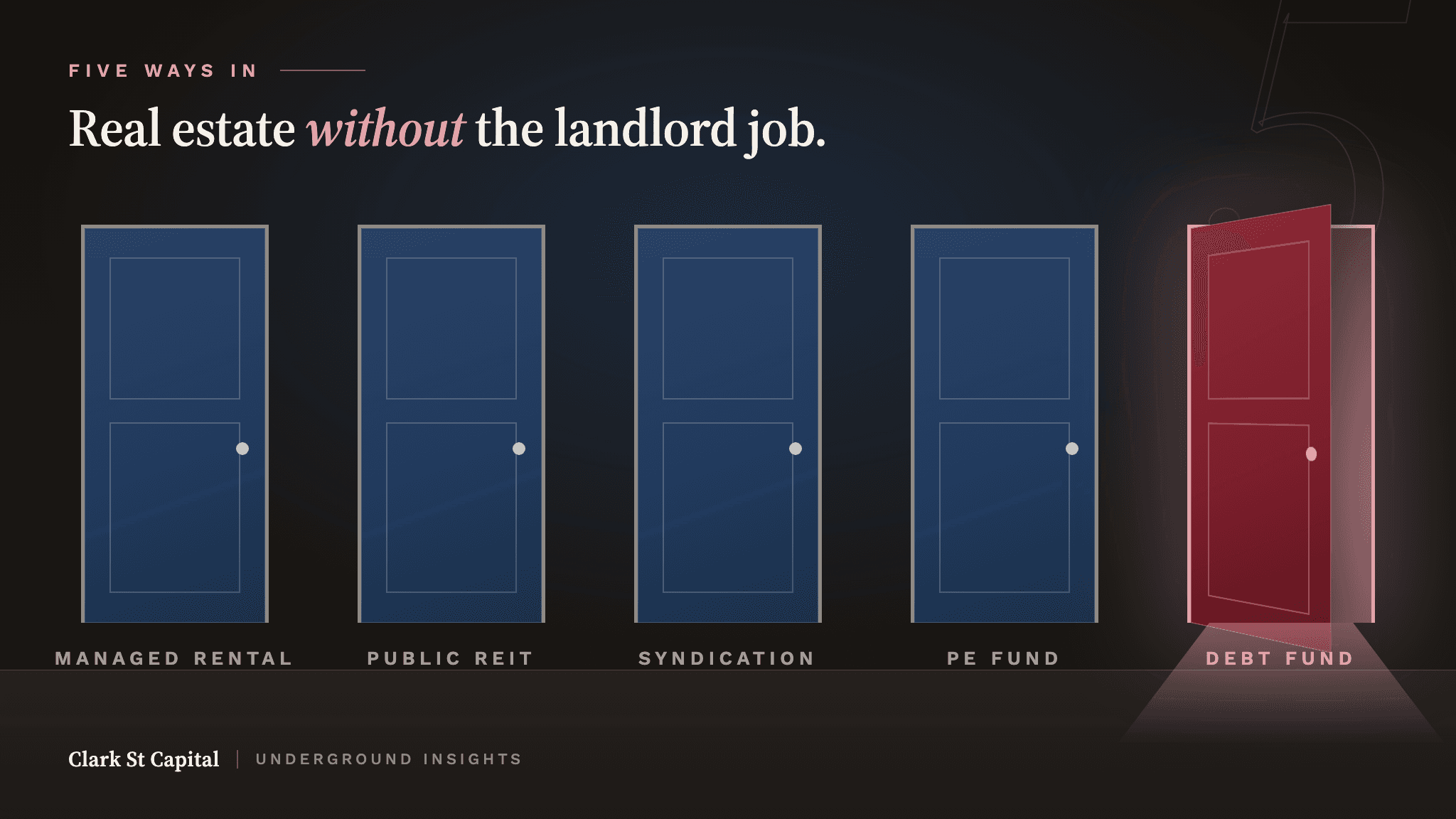
You can invest in real estate without being a landlord through five main hands-off paths: a professionally managed rental, a publicly traded REIT, an equity syndication, a private equity real estate fund, or a real estate debt fund.
They differ sharply in terms of the time commitment, control and risk.
TL;DR
- Being a landlord is one option, not the only door in.
- Five paths: a managed rental, a public REIT, an equity syndication, a private equity real estate fund and a real estate debt fund.
- "Passive" isn't one thing. Score each on three axes: your time, your control and your risk.
- A REIT trades like a stock. A syndication pairs the least control with the most risk. A private equity fund spreads that risk across deals but keeps you in the equity seat. A managed rental is still a job with a middleman.
- Of the options that are actually real estate and actually passive, secured debt is the most genuinely hands-off.
The menu: five ways in that aren't landlording
Start with what each one actually is, in plain terms.
A managed rental means you own the property, but a property manager handles the resident, the maintenance and the rent collection. You own the asset. You pay someone to absorb the headaches.
A public REIT means you buy shares of a company that owns real estate. It sits in your brokerage account next to your stocks. Easy to buy, easy to sell.
An equity syndication means you invest as a limited partner alongside an operator who buys a specific property. You own a slice of the equity in that one deal.
A private equity real estate fund means you invest in a pool that buys equity in multiple properties, picked by a professional manager. Same seat as a syndication, spread across several deals instead of one.
A real estate debt fund means you lend against real estate instead of owning it. The fund makes loans secured by property and you earn income from the interest the borrowers pay.
Five doors. All of them let you skip that 11pm tenant call, but that doesn't make them equal.
"Passive" isn't one thing
Here's where most people go wrong. They hear "passive" and they think about one thing: time. Will this eat my evenings or not.
Time is only one element. There are three and you have to score all of them:
- Time. How much of your attention does it actually take?
- Control. How much say do you give up over what happens to your money?
- Risk. How much can you lose and what has to go wrong for you to lose it?
An investment can be completely passive on time and still hand you a ton of risk or take away all your control. The options on this menu are not equally passive once you look at all three. Score them honestly and the picture likely changes.
Scoring the five, honestly
A managed rental is low on time, but not zero. You still get the call when the furnace dies and the manager needs a decision on a two thousand dollar repair. You keep control. And you carry all of one property's risk, concentrated in a single house on a single street. It's the least passive of the five and the least diversified.
A public REIT is near zero on time and near zero on control, which sounds ideal until you notice the catch. It trades like a stock, because it is a stock. It swings with market sentiment and moves with the same forces as the rest of your portfolio, which is the exact thing you were trying to diversify away from. You bought volatility, not real estate behavior.
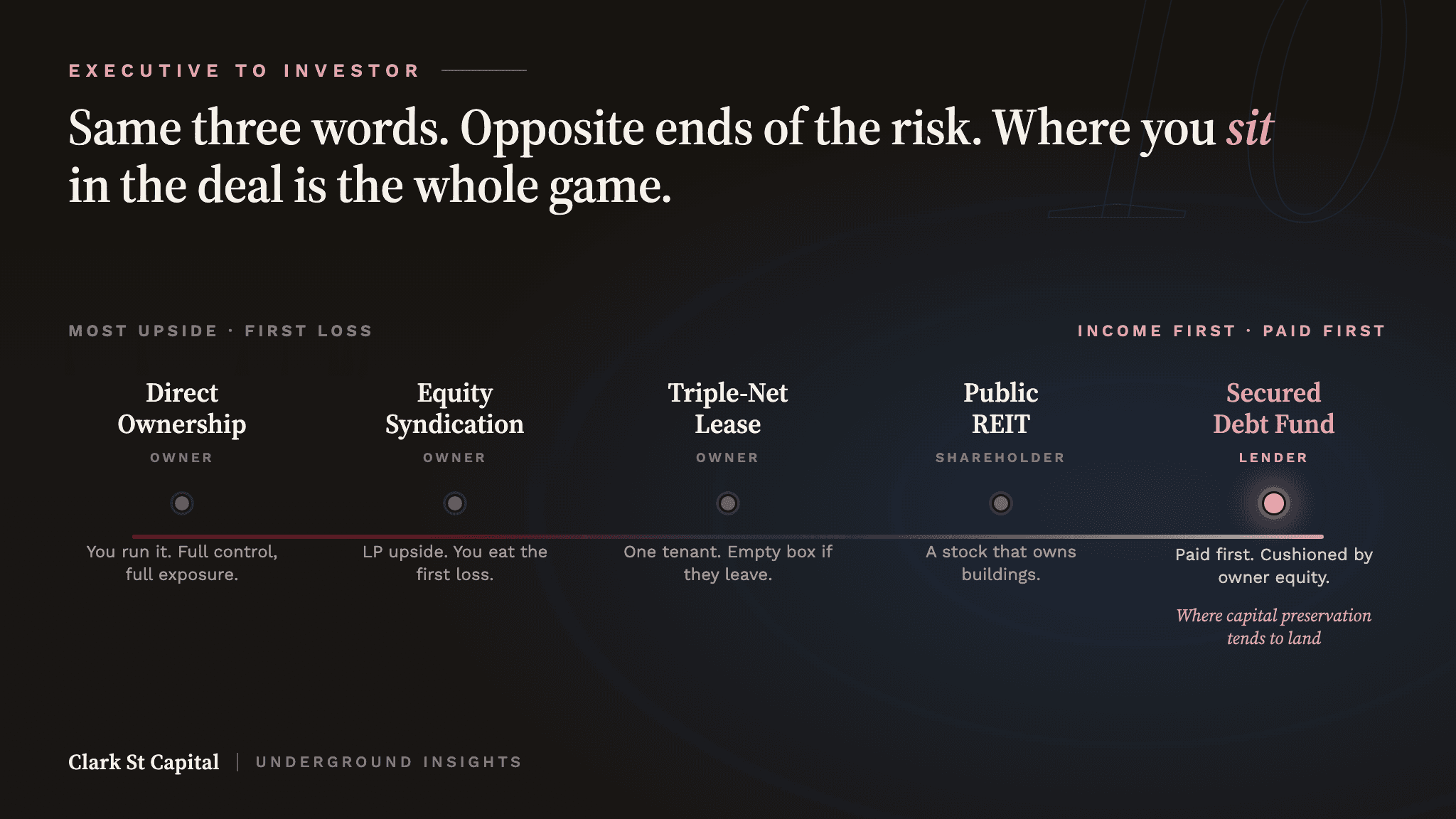
An equity syndication is near zero on time and you hand almost all control to the operator. Here's the part the pitch skips: you're sitting in the equity, which carries the most risk in the deal, but the biggest upside potential. When it works, it can pay the most. When it doesn't, the equity gets eaten first. (We break down that exact tradeoff in our companion piece, Debt Fund vs. Real Estate Syndication.)
A private equity real estate fund fixes one problem with the syndication and keeps the other. Spreading across several deals softens the single-property risk. But you're still in the equity seat on every one of those deals, still last in line on each and now with a manager's fee stack between you and your return. In many funds you also commit the money before you know which properties it buys. Diversified equity is still equity.
A real estate debt fund is near zero on time and you give up control the same way you would as an LP. But you sit in a different seat. You're the lender, secured by a lien, cushioned by the owner's equity underneath you. You trade the home-run upside for getting paid first. You're hitting singles and doubles.
So the option marketed hardest, the syndication with the big upside number, is the one that quietly pairs the least control with the most risk. And the one nobody puts on a billboard, secured debt, is the one built to protect the downside.
Why secured debt is the most genuinely passive of the real options
Of the five, the debt fund is the one that's both hands-off and actually real estate behaving like real estate. Income first, backed by property, not tied to whatever the stock market did today.
The mechanics are simple. You lend. The fund holds a first-position lien on the property. The borrower pays interest. You collect income. No tenants, no operator's five-year business plan riding on your money, no brokerage-account whiplash.
That answers both things the busy professional actually wanted. You didn't want a second job. You didn't want another investment that moves in lockstep with your stocks. Secured debt sidesteps both.
The limits
None of this is free, so let's walk through the tradeoffs.
A debt fund is illiquid. Unlike a REIT, you can't sell it on a Tuesday afternoon. That's the price of not being chained to the stock market.
You give up the ceiling. If a syndication hits its home run, the equity makes more than the lender ever will. Debt trades that ceiling for a floor.
And it's for accredited investors. It's a relationship, not a button you click in an app.
A managed rental or a REIT still has a place for you, depending on where you are on your financial journey. This isn't "one option wins." It's knowing your goals and what you're actually buying on all three axes before you buy it.
Which seat fits you
Being a landlord was never the only way in. The real question isn't whether to invest in real estate. It's which seat matches the time, control and risk you actually want to carry. For the busy professional who wants income without a second job and without a stock-market proxy, secured debt deserves a serious look.
Want the operator's view on how these paths behave in a real cycle, told through actual deals instead of projections? That's what our newsletter, Underground Insights, covers every month. It's not tips and tricks. It's real deals and the actual lessons we've learned putting capital to work and protecting it.
Sign up at clarkst.com/newsletter.
Prefer to listen? Subscribe to the Real Estate Underground podcast for the same conversations, unscripted.