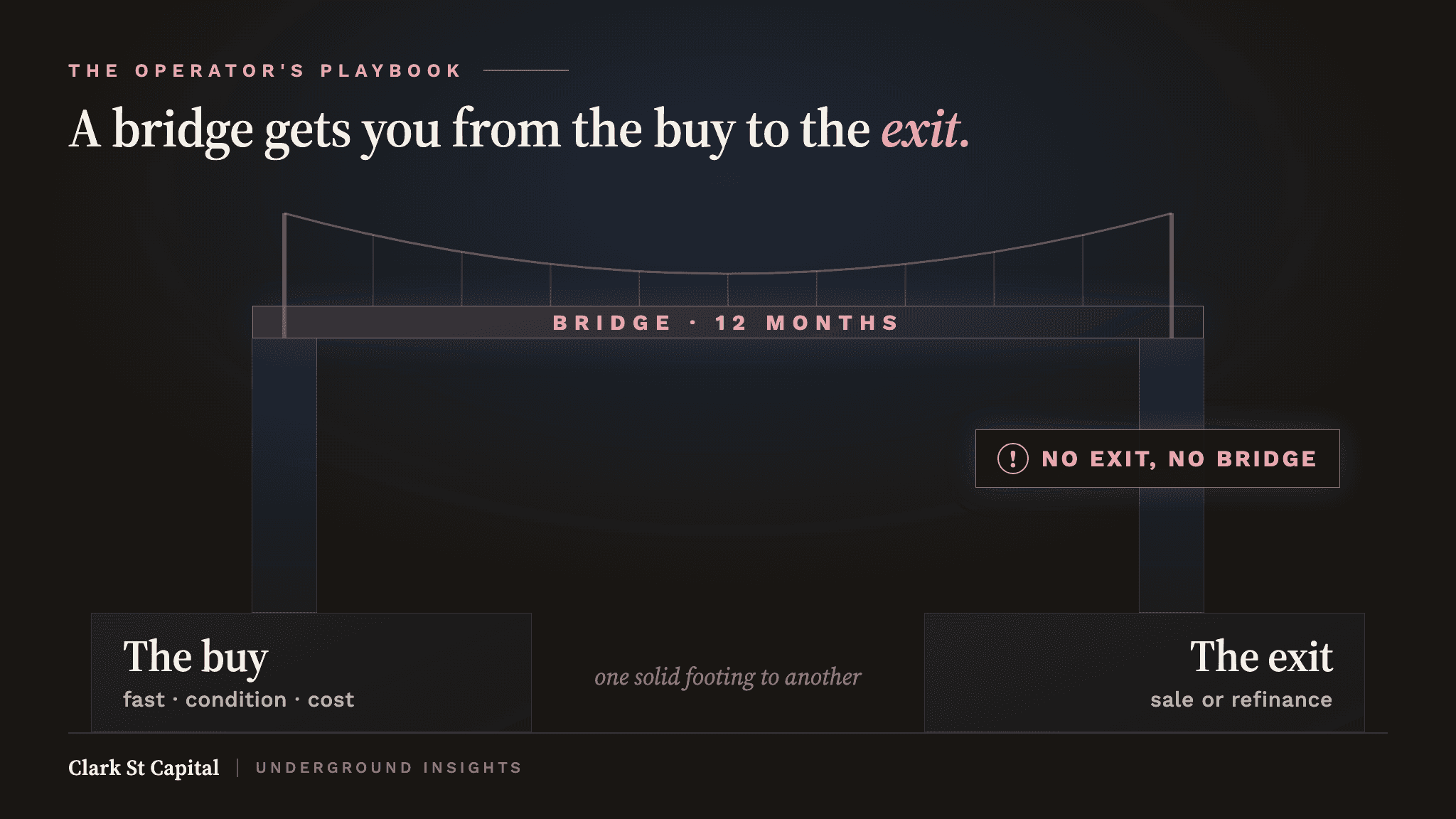
You found a deal. You go looking for a fix and flip loan. Maybe you type “hard money” into a search bar and you call three lenders.
One says 80%.
One says 90%.
One says not a dollar over 70%.
All three are talking about your deal and none of the numbers match. So which one is right?
They all are. But they’re measuring different things. And until you know which number is which, you can’t tell what you will actually be able to borrow on the house in front of you.
TL;DR
- Loan-to-cost and loan-to-value are two different ceilings on the same loan. Your loan is the lower of the two.
- Loan-to-cost is 90 percent of the purchase plus 100 percent of the rehab. That's measured against what the project costs you.
- Loan-to-value is 70 percent of the after-repair value. That's measured against what the finished house is worth.
- On a real deal the two produce different numbers. The smaller one is your loan. The gap is cash you bring to the table.
- Run both before you make an offer. That's how you know your number instead of hoping a lender imposes one on you.
Why three lenders give you three numbers
Every leverage number is a fraction. The confusion is that lenders quote different fractions without saying which is which.
Loan-to-cost measures the loan against your total project cost. Purchase cost plus rehab. When we say up to 90 percent of the acquisition and 100 percent of the rehab, that's a loan-to-cost figure. It answers one question: how much of what you are spending will the loan cover.
Loan-to-value measures the loan against the after-repair value (ARV). What the house sells for once the work is done. When we say the loan will not exceed 70 percent of the after-repair value, that's loan-to-value. It answers a different question: how much equity sits underneath the loan when the project is finished.
They're not the same number and they do not move together. Confuse them and you will underwrite a deal that dies in underwriting. This is the piece a lot of borrowers get wrong and it’s why the quotes don’t line up.
The rule: your loan is the lower of the two
Here is the mechanic nobody explains up front. We run both numbers on your deal and the loan is capped at whichever one comes in lower.
Loan-to-cost sets one ceiling. Loan-to-value sets another. The tighter of the two wins. Not the average, not the friendlier one. The lower one. That single rule is the difference between a number you can plan around and a surprise at the closing table.
One Connecticut deal, walked through
Let me use round numbers so the arithmetic is easy to follow. Illustrative deal, no real address.
You’re buying a single-family in a nice Connecticut submarket.
- Purchase price: $300,000
- Rehab budget: $100,000
- Total project cost: $400,000
- After-repair value: $500,000
Now run both numbers.
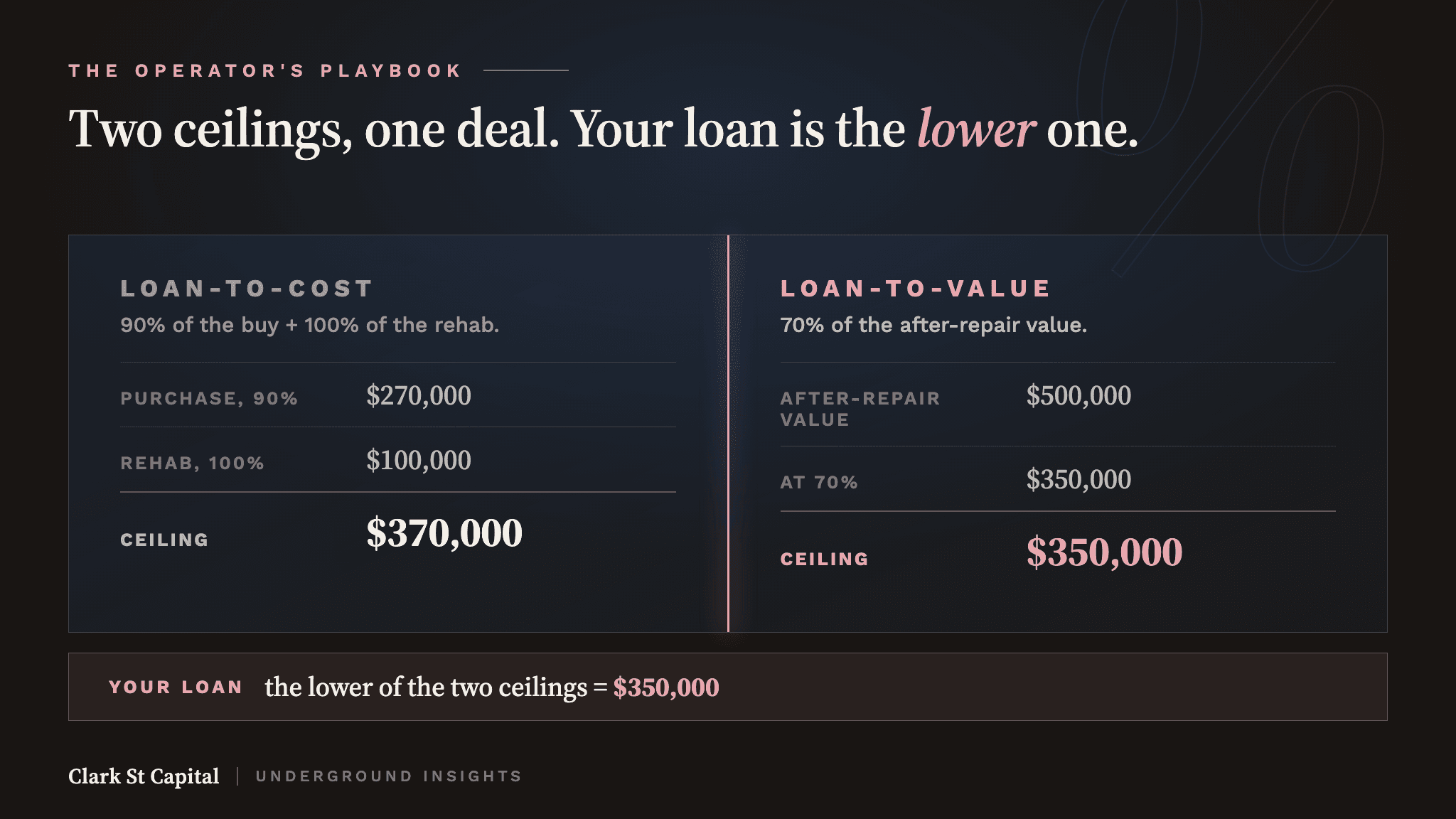
Loan-to-cost. Ninety percent of the $300,000 purchase is $270,000. One hundred percent of the $100,000 rehab is $100,000. Add them and loan-to-cost allows $370,000.
Loan-to-value. Seventy percent of the $500,000 after-repair value is $350,000.
Two ceilings, two different numbers. $370,000 from loan-to-cost. $350,000 from loan-to-value. The rule says the loan is the lower one, so your loan is $350,000.
That $20,000 gap is real cash you bring to the closing table you would not have planned for if you only ran the 90 and 100 math. On a $400,000 project with a $350,000 loan, you are putting in $50,000 of your own money, not the $30,000 the loan-to-cost number alone suggests.
It can run the other way too. On a light rehab where the finished value is high relative to what you spend, the 70% ARV cap gives you room and loan-to-cost becomes the max loan. The rule doesn't change. Run both, take the lower.
What this tells you before you make an offer
The point of this isn’t to memorize two fractions. It’s so you know your real number before you commit to a purchase price.
The after-repair value is the input people fudge. If your ARV is a hope instead of a comp, the loan-to-value ceiling moves and your leverage moves with it. Pull the finished comps that actually closed, not the ones you wish for. That number sizes the loan.
Do that and you walk into the deal knowing three things: your loan, your cash in and your margin. The lender who understands your specific deal is the one who runs both figures with you and tells you which one binds, instead of quoting a headline percentage and letting you find out later.
We break down the other inputs that move your loan in the four things that decide a fix-and-flip loan and how our Connecticut lending works start to finish in fix-and-flip loans in Connecticut.
How we size it at Clark St
Clark St Lending is a private lender. We fund Connecticut single-family and small multifamily flips and value-add deals from our own investor capital.
Up to $2M per deal. Loan-to-cost up to 90 percent of the acquisition and 100 percent of the rehab. Loan-to-value capped at 70 percent of the after-repair value. Your loan is the lower of the two, sized on your actual deal. Loans run from about $100,000 to $2M. Closed in under 30 days, construction draws are funded in 24 hours or less, on a 12-month interest-only term. The floor to get in the door is a 660 credit score.
We hate surprises. When you submit a deal, we run both figures and walk you through your real number, the one you can build a plan on.
Submit your deal at clarkst.com/submit-your-deal and we’ll size it against both LTC and LTV figures together.
And as always, if you have questions, give me a shout. I'm a cheap date.
About Ed Mathews
Ed is the founder of Clark St Capital, Clark St Homes and Elevista. He started investing in 2011 after analyzing deal after deal and making zero offers, until a mentor handed him a pen and made him sign his first contract. Since then, Clark St has operated across single-family, multifamily and land development, with Ed also invested as a limited partner in funds and large multifamily projects. Ed also spent more than two decades in Silicon Valley building systems for global companies. He hosts the Real Estate Underground podcast, with new episodes every Tuesday at 12pm.