A bridge loan is one of the most useful tools in a flipper's toolkit and one of the easiest to misuse. The name tells you everything. It's a bridge. It gets you across a specific gap, from one solid piece of ground to another. The trouble starts when people treat it like a destination instead of a crossing.
I've used bridge loans to buy houses and I now write them for other operators. So let me tell you exactly when a bridge is the smart move and when it's a mistake.
TL;DR
- A bridge loan is short-term financing that carries you from the buy to the exit. The exit is a sale or a refinance. If there's no clear exit, there's no bridge, there's just expensive debt.
- It's the right tool when you need speed, when the property needs work a bank will not fund and when you have a real plan to pay it off inside 12 months.
- It's the wrong tool when the exit is fuzzy, when the deal only works at the cheapest possible rate or when you're really trying to hold the property long-term.
- Our bridge at Clark St is up to $2M, up to 90% of the purchase and 100% of the rehab, draws in 24 hours or less, closed in under 30 days, on a 12-month interest-only term.
- Before you borrow, underwrite the exit, not just the entry. The buy is the easy half. The payoff is where bridge loans can go sideways.
What a bridge loan actually is
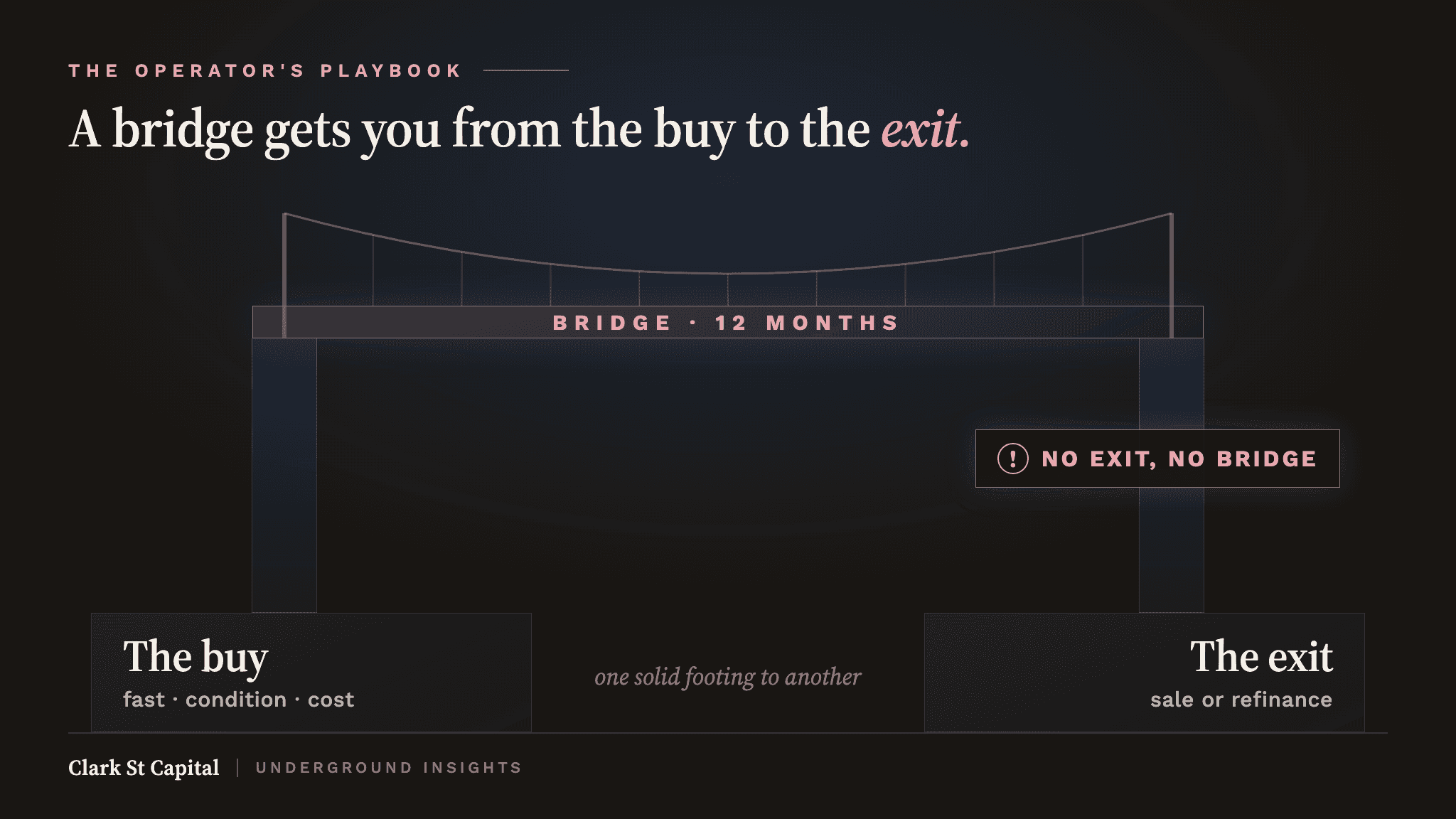
A bridge loan is short-term money that connects two points in a deal.
Point one is the purchase. The seller needs to close fast, the house needs work and a bank can't move quick enough to make it happen. Point two is the moment you get out, either by selling the finished property or by refinancing into long-term debt.
The bridge covers the space in between. It's built for speed and for construction. It closes fast, it releases rehab money in stages and it's short-term by design. Ours runs 12 months, interest-only, which is plenty of runway for a normal flip or value-add project.
What it's not is permanent financing. A bridge is not meant to sit on a property for years and the pricing reflects that. You're paying for the crossing, not for a place to live.
When a bridge is the right tool
A bridge earns its keep in three situations and the best deals hit all three at once.
Speed. You have a seller who wants certainty and a fast close. A bridge lets you make and keep the promise. In a low-inventory market like Connecticut, the operator who can actually close is the one who wins the deal.
Condition. The house needs work. A bank wants a livable property with a clean appraisal. A bridge funds the purchase and the rehab together and releases the construction money as you go.
Leverage on cost. You want to keep more of your own cash working. A bridge sized on the cost of the project, not just the current value, lets you put less in and do more deals.
Underneath all three is the thing that actually matters. You have an exit. You know how this loan gets paid off and you know it happens well inside the term. That is what turns a bridge from a risk into a tool.
When to walk away
Here is where I'll talk you out of the deal.
Walk away when the exit is fuzzy. If you can't say in one sentence how this loan gets repaid and roughly when, you don't have a plan, you have a hope. A bridge with no exit is the fastest way to turn a good deal into a fire sale or worse.
Walk away when the deal only works at the lowest rate. Bridge money costs more than a mortgage because it's short-term and the risk is front-loaded. If your numbers pencil at a bank rate and collapse at a bridge rate, the margin is too thin. The rate didn't kill the deal. The purchase price did.
Walk away when you're really trying to hold. If the plan is to buy a rental and keep it for the long haul, never bridge it and hope to figure out the refinance later. Line up the long-term financing as part of the plan or buy it with the right loan from the start.
None of these are the lender being difficult. They're the difference between success and a train wreck.
Underwrite the exit before the entry
The single biggest mistake I see is an investor who plans the buy in detail and treats the payoff as an afterthought.
Flip the order. Before you sign the bridge, know your exit. If you're selling, know the after-repair value and what comparable finished houses are actually closing for, not what you hope they fetch. If you're refinancing, know that the finished value and the rent will support the new loan, because the takeout lender will underwrite both.
Do that math first and the bridge becomes way easier to do. The buy is the part everyone focuses on. The exit is the part that separates operators who repeat from operators who get stuck. If you're financing a BRRRR specifically, we'll walk through the full bridge-in, refinance-out path in financing the BRRRR.
How we build the bridge
Clark St Lending writes bridges for Connecticut single-family and small multifamily flips and value-add deals.
- Up to $2M per deal.
- Up to 90% of the acquisition and 100% of the rehab, which is loan-to-cost, measured against what the project costs you.
- The loan will not exceed 70% of the after-repair value, which is the loan-to-value ceiling that protects both you and our investors.
- Closed in under 30 days.
- Construction draws are funded in 24 hours or less.
- A 12-month interest-only term, with six months of interest held in escrow so you're not feeding the loan out of pocket while the crew is still working.
The floor to get in the door is a 660 credit score. Above that, the rate is set by:
- Your experience
- Your financial strength
- The risk in the specific project
When you submit a deal, we underwrite the whole crossing with you, the buy and the exit and we will tell you straight if the exit doesn't hold up.
Submit your deal at clarkst.com/submit-your-deal and we'll size the bridge and pressure-test the deal together.
About Ed Mathews
Ed is the founder of Clark St Capital, Clark St Homes and Elevista. He started investing in 2011 after analyzing deal after deal and making zero offers, until a mentor handed him a pen and made him sign his first contract. Since then, Clark St has operated across single-family, multifamily and land development, with Ed also invested as a limited partner in funds and large multifamily projects. Ed also spent more than two decades in Silicon Valley building systems for global companies. He hosts the Real Estate Underground podcast, with new episodes every Tuesday at 12pm.