The first time an investor hears "hard money," two things happen. They sense it's expensive. And they sense it's a little bit shady. Both reactions are fair. Neither one tells you whether it's the right tool for the deal in front of you.
I've been on both sides of this. I've borrowed hard money to buy houses and I now lend to other operators as a private lender. So let me take the mystery out of it, in plain English, the way I would explain it to you at a meetup.
TL;DR
- Hard money is a short-term loan secured by the property, not by your salary. The house is the collateral, so the lender cares more about the deal than about your tax returns.
- You pay for speed and flexibility. A bank is cheaper. A bank also will not close in three weeks and will not lend on a house that needs a new roof.
- It is the right tool for a fix and flip, a BRRRR or any deal where you have to move fast on a property a bank will not touch. It is the wrong tool for a rental you plan to hold for thirty years.
- Rates run higher than a mortgage because the money is short-term and the risk is front-loaded. Our private lending runs 10 to 15% interest-only for 12 months, plus points at closing.
- The true line between a good lender and a predatory one is simple. A good lender wants your deal to work. A predatory one is quietly hoping it doesn't.
What hard money actually is
A hard money loan is a short-term loan secured by real estate.
The property is the collateral. If the deal goes bad, the lender takes the house. Because the loan is tied to the asset and not to your paycheck, the lender underwrites the deal first and you second.
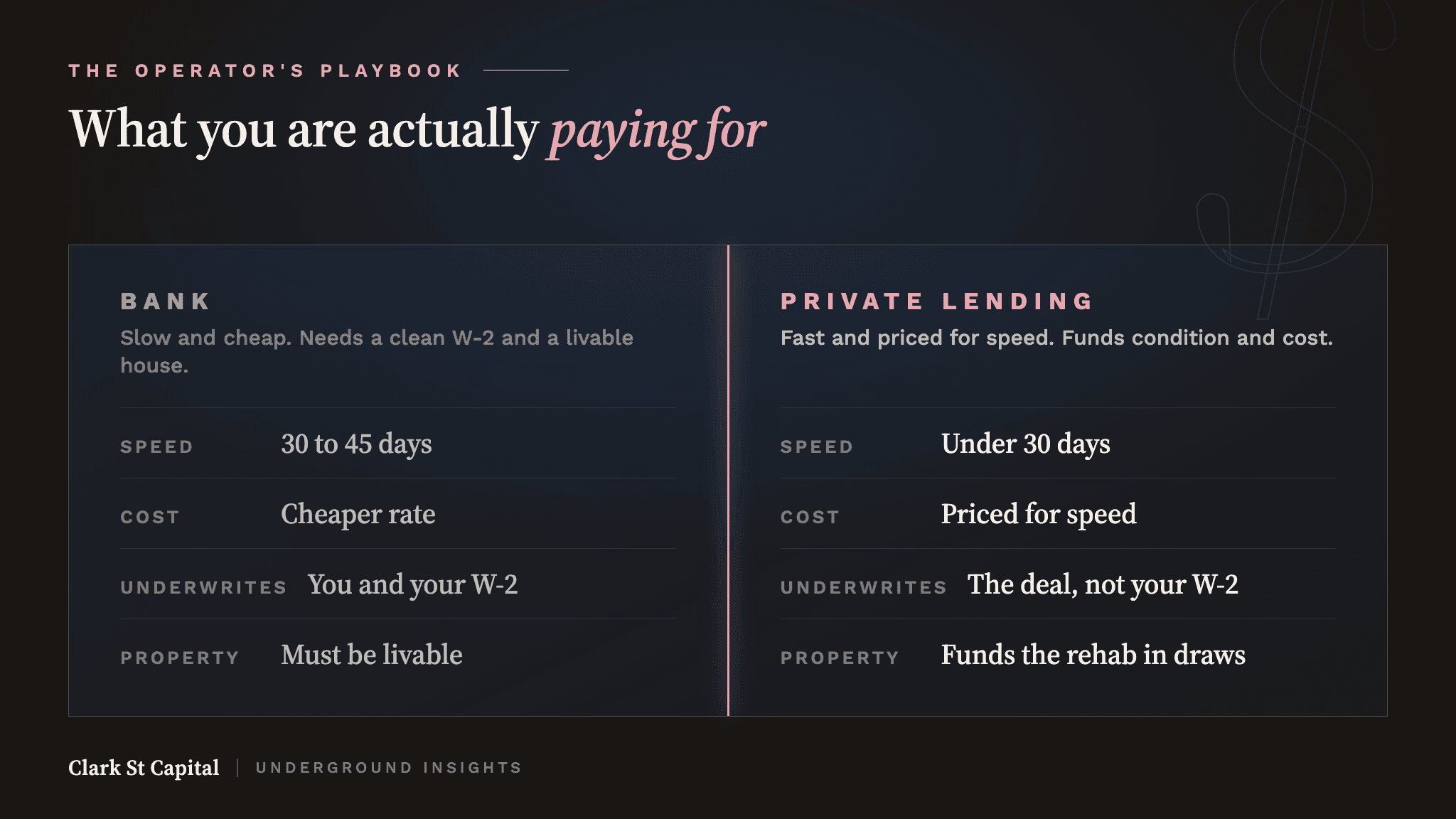
Compare that to a bank. A bank underwrites you. The bank pulls your tax returns, adds up your personal debts and decides how much house your income can carry. Then it wants a property in livable condition, an appraisal and 30 to 45 days. That process is fine when you are buying a home to live in. It's useless when you're trying to buy a distressed house in a hot market before someone else does.
Hard money exists to fill that gap. It's fast, it funds properties that need work and it sizes the loan against the deal instead of against your W-2.
Why it costs more
Here's the part that scares people and here is why it shouldn't.
Hard money is priced higher than a mortgage and private lending like ours sits in the same range. Our loans run 10 to 15% interest-only for 12 months, plus points charged at closing. The exact rate depends on your experience, your financial strength and the risk in the specific project. A newer operator pays more. A proven one pays less.
That number looks steep next to a 7% mortgage until you remember what you're buying. You're not buying 30 years of financing. You're buying 6 to 12 months of speed on a deal that makes its money on the buy and the rehab, not on the interest rate.
Run the math on a real flip. If a house makes you $60,000 on a nine-month project, the difference between 7% and 12% money on a $350,000 loan is a few thousand dollars. The bank that would have saved you that few thousand also would not have closed in time for you to win the deal. Cheap money you can't get on your timeline is worth nothing. That's the trade and for the right deal it's an easy one.
When hard money is the right tool
Hard money earns its cost in a few specific situations.
Speed. You have a seller who wants to close fast and a bank that can't move that quickly.
Condition. The house needs work a bank will not lend against. Hard money funds the rehab in draws as you go.
Leverage on cost. You want to put less of your own cash in the deal and finance the purchase and the renovation together.
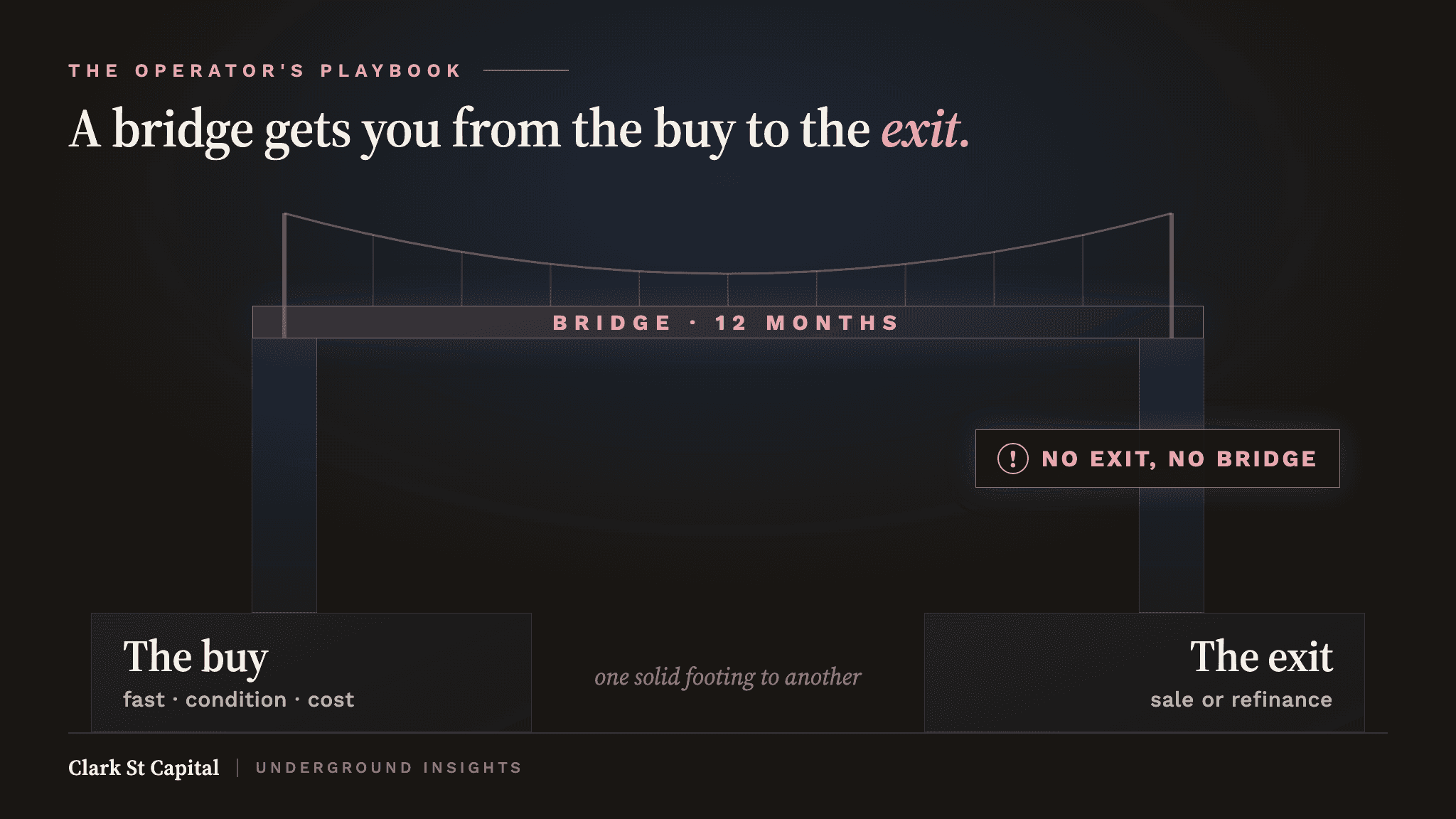
A fix and flip is the classic case. So is a BRRRR, where you use short-term money to buy and rehab, then refinance into a long-term rental loan once the property is leased. In both, the short-term loan is a bridge to a clean exit, not a place to park debt forever.
When it's the wrong tool
I will talk you out of it as fast as I will fund it.
Hard money is the wrong tool for a property you intend to buy and hold as a rental from day one. If the house is already livable and rented and you just want long-term financing, get a DSCR loan or a conventional mortgage. Never pay short-term rates for a long-term hold.
It's also the wrong tool if your numbers only work at the lowest possible rate. If a deal pencils at 7% and dies at 12%, the deal is too thin. The rate isn't your problem. The margin is. A good lender will tell you that before you sign, not after.
How to tell an operator from a predator
The national hard money world has plenty of shops that feel predatory and the fear isn't irrational. So here is how I'd size up any lender, including us.
A good lender wants your deal to succeed. Their money comes from your project working, you refinancing or selling and you coming back for the next one. When a project hits trouble, they work with you to fix it first. Foreclosing is the last resort, not the plan.
A predatory lender is built the other way. The terms are designed so a stumble hands them your equity. They're quietly rooting for the deal to slip so they can take the asset. You can feel the difference in the first conversation. One is asking about your exit. The other is asking about your down payment.
The reason I lend the way I do is that I spent years on your side of the table. I've done more than 75 flips of my own in Connecticut and Rhode Island. I price a deal the way an operator would, because I've sat where you're sitting, staring at a project that ran long and wondering if the lender was a partner or a problem. That's why what we run is operator-run private lending, not a hard money shop.
Where Clark St fits
Clark St Lending is operator-run private lending for Connecticut single-family and small multifamily deals.
- Up to $2M per deal
- Up to 90% of the purchase and 100% of the rehab
- Construction draws are funded in 24 hours or less
- Closings in under 30 days
The floor to get in the door is a 660 credit score.
If you want the full mechanics of how a Connecticut fix and flip loan is structured, we walk through the whole thing in how fix-and-flip loans work in Connecticut.
And if you're weighing hard money for a deal and want a straight read on whether it's the right tool, take a look at clarkst.com/borrow. We'll tell you when it fits and when it doesn't.
About Ed Mathews
Ed is the founder of Clark St Capital, Clark St Homes and Elevista. He started investing in 2011 after analyzing deal after deal and making zero offers, until a mentor handed him a pen and made him sign his first contract. Since then, Clark St has operated across single-family, multifamily and land development, with Ed also invested as a limited partner in funds and large multifamily projects. Ed also spent more than two decades in Silicon Valley building systems for global companies. He hosts the Real Estate Underground podcast, with new episodes every Tuesday at 12pm.