TL;DR
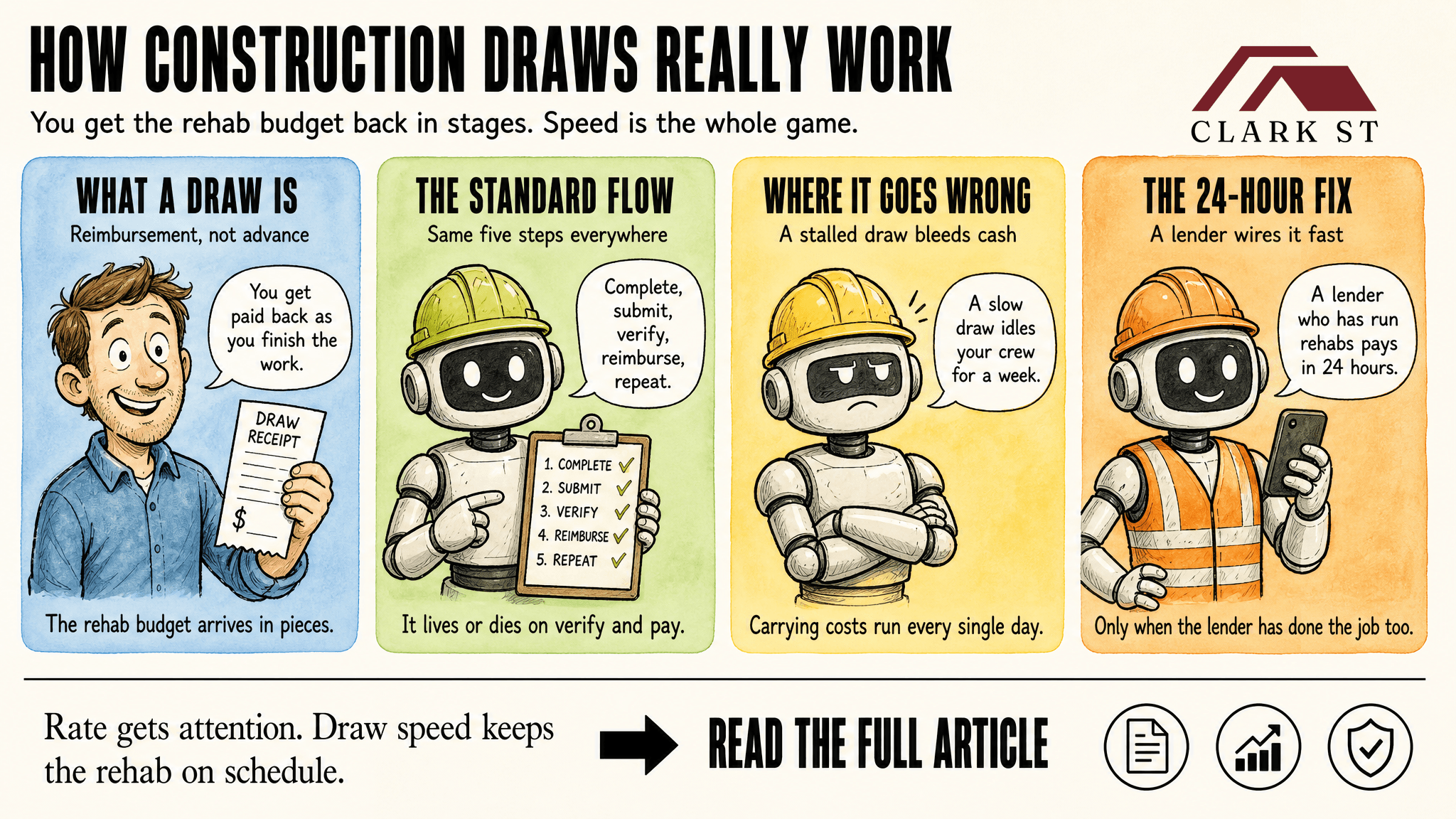
- A construction draw reimburses completed rehab work in stages. You don't get the rehab budget up front.
- The standard flow is simple:
- Complete a stage
- Submit it
- Get it verified
- Get reimbursed
- Fund the next stage
- It breaks when a lender who doesn't understand the work sits on your draw for a week or more while your crew stands around and your money is already spent.
- A stalled draw bleeds two ways: carrying costs run every day and an idle crew is a crew you can lose to another job.
- A 24-hour draw turn is only possible when the lender approving it has run rehabs himself and can trust the work without sending a third-party to check.
What a draw actually is
On a rehab loan you don't get the renovation money in a lump sum at closing. You get it back in stages as you finish the work. That's a construction draw.
Think of it as a reimbursement, not an advance. You spend your money moving a stage of the job forward. The lender verifies that stage is done. Then they release the cash for it and you roll it into the next stage. The rehab budget is real and it's yours. It just arrives in pieces, tied to work that's actually on the ground, after you complete the work.
This trips up first-time flippers who assume they'll get a check for the full rehab on day one. Nobody funds it that way and for good reason. It protects the lender from paying for work that never happens and it keeps you honest about the scope. But it also means one thing matters more than almost anything else in the loan: how fast that reimbursement hits your bank account.
The standard flow, step by step
Every draw process, at every lender, runs the same five steps.
You complete a stage of work. Demo done. Rough plumbing and electrical in. Drywall hung. Whatever the next line on your scope is. You submit the draw request. You tell the lender what's finished and how much of the budget it represents. The work gets verified. Someone confirms the stage is actually done, either by photos, a video walkthrough or an inspection. You get reimbursed. The lender releases the money for that stage. You fund the next stage and start the cycle again.
That's it. There's no magic to it. The whole thing lives or dies on step 3 and step 4. How fast does the work get verified and how fast does the money come back after it's verified. Everything else is paperwork.
Where it goes wrong
Here's the part nobody warns you about until you're standing in it.
You finished a stage. Your crew is ready to start the next one. You submitted the draw three days ago and you're in a holding pattern.
The lender's file is sitting with someone who's never swung a hammer. So they can't just look at your photos and know the work is real. They order a third-party inspection. The inspector is booked out. When the report finally lands it goes to a servicing desk that processes it whenever someone gets to it.
Too many steps. Zero urgency.
A week goes by. The whole time, your money for that stage is already spent. You paid the crew. You paid for materials. You're out of pocket, waiting on your reimbursement to arrive. The job isn't moving.
This is the failure that costs flippers real money and it has almost nothing to do with your interest rate. A lender who doesn't understand the work will always be slow on the draw, because they can't tell a finished stage from a fantasy without sending a stranger to go check.
What a slow draw actually costs
Let's put numbers on it. Take a middle-of-the-road Connecticut flip funded at $300,000.
Your interest runs about $3,000 a month, roughly $100 a day. On top of that you're carrying taxes, insurance and utilities on the property. Call that another $800 a month, about $27 a day. So the deal costs you around $125 every single day you own the property, whether work is happening or not.
Now a draw stalls for 10 days. That's about $1,250 in carrying costs burned while nothing got done. You didn't get an inch closer to selling the house. You just paid to stand still.
And that's the smaller cost. The bigger one is your crew. A good crew doesn't wait around unpaid while your lender sits on a draw. They take the next job. When you finally get funded and call them back, they're installing someone else's kitchen for two weeks. Now your 10-day draw delay just became a month-long hole in your timeline, which is another couple of thousand in carrying costs.
A slow draw isn't an inconvenience. It's a profit leak and it runs the entire time the money is stuck.
Why the 24-hour turn is the fix
The fix is boring but it's the whole ballgame.
You submit completed work and the money comes back in 24 hours or less. Your crew never stops. The leak never appears.
But you can't buy a fast draw from just anyone. A 24-hour turn is only possible when the person approving the draw already knows what the work looks like. When they've walked your project, hung the drywall on their own projects, chased the plumber and carried the job that ran long. They can look at the pics or video of your walkthrough and know in minutes that the stage completion is real. There's no third-party to schedule. There's no risk model to babysit. They read your scope and they walked the project with you. Now, they see the work progress and they wire the money.
That's the quiet reason draw speed and lender experience are the same conversation. A desk jockey who looks at your deal through a spreadsheet has to wait on an outside inspector because they have no other way to trust the work.
An operator who has run rehabs doesn't. The 24-hour turn isn't a promise on a page. It's what happens naturally when the lender has done the job.
How this fits the whole loan
Draw speed doesn't live in a vacuum. It's one piece of a structure built so your own cash isn't floating the renovation.
When a loan funds the acquisition, reimburses rehab progress efficiently and turns them fast, your money isn't sunk into the renovation waiting on a broken process.
You complete project stages, the draw comes in and the budget keeps cycling until there's nothing left to do. That's the key: keep the job moving and keep your cash free to solve the surprise behind the wall or start the next deal.
A loan that funds only the purchase or drips the rehab back slowly, quietly puts you in a hole. You're financing the renovation yourself.
Rate gets all the attention. Draw speed is what actually keeps a rehab on schedule. A 24-hour turn is the difference between a job that moves and a job that bleeds.
This is how we built our loan operations at Clark St. If you have a Connecticut-based single family flip or small multifamily project (2-4 units) and want to see how our draw process would work on your deal, here's how we fund deals: /borrow.
If you have any questions, I'm a cheap date. Give me a shout. I'm happy to help you.
About Ed Mathews
Ed is the founder of Clark St Capital, Clark St Homes and Elevista. He started investing in 2011 after analyzing deal after deal and making zero offers, until a mentor handed him a pen and made him sign his first contract. Since then, Clark St has operated across single-family, multifamily and land development, with Ed also invested as a limited partner in funds and large multifamily projects. Ed also spent more than two decades in Silicon Valley building systems for global companies. He hosts the Real Estate Underground podcast, with new episodes every Tuesday at 12pm.