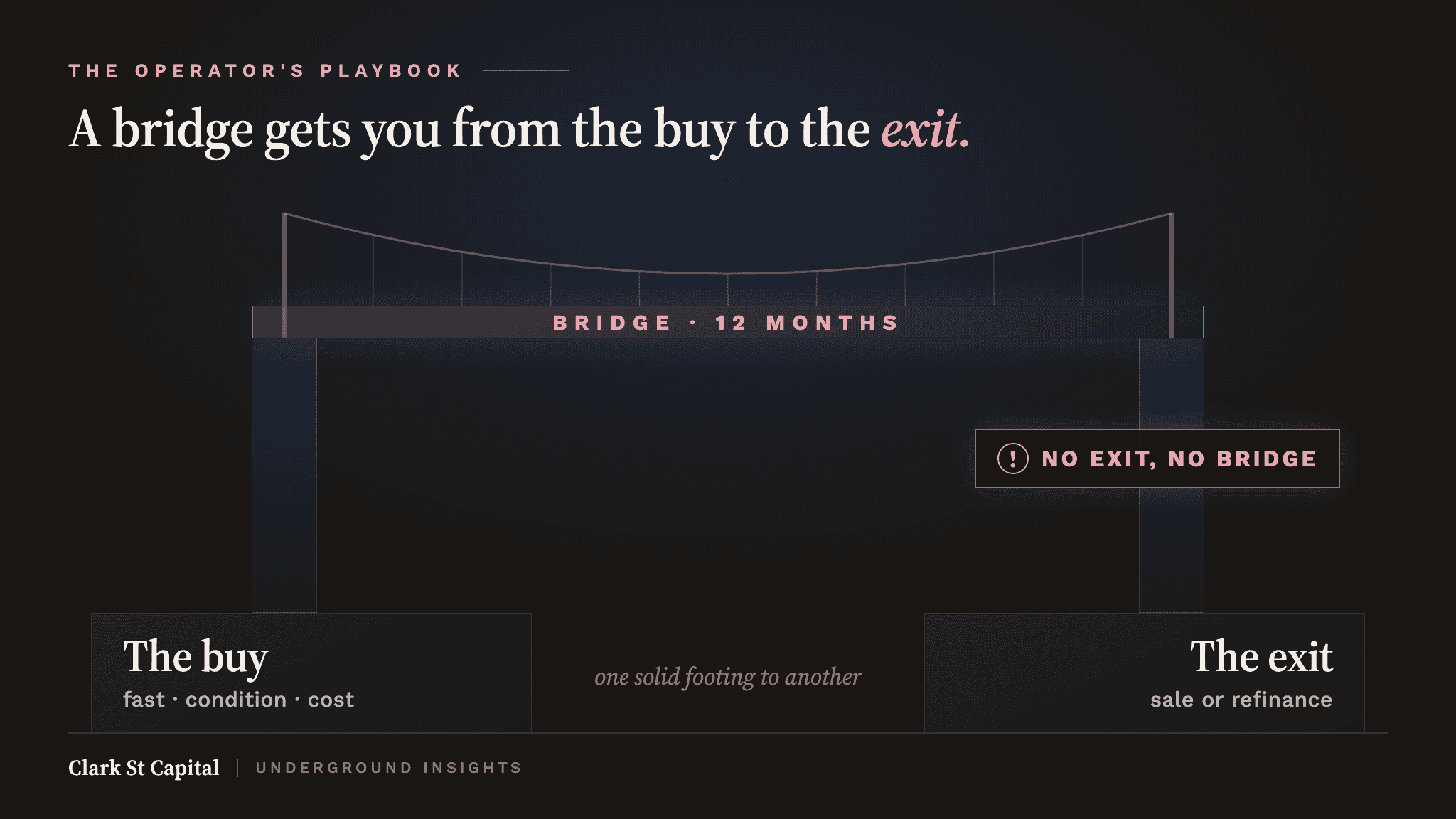
Some people running a BRRRR playbook think it takes one loan. It actually takes two. The reason the strategy stalls for so many investors is they line up financing for the buy and don't plan the exit. Then they get into a little bit of trouble when they find themselves in month ten of a fix and flip loan and they're scrambling to find a long-term loan to pay off the first loan.
There's a much easier way. Here's the whole path, as simply as I can put it:
A short-term bridge loan buys the house and funds the rehab. Once the property is rented, you refinance into a long-term DSCR loan that pays off the bridge and hands you back most of the cash you put in.
BRRRR stands for Buy, Rehab, Rent, Refinance, Repeat. The first three R's run on our money. The fourth R is where our loan ends and your permanent debt begins. Knowing exactly where that line sits is the difference between a clean repeat and a mad scramble.
TL;DR
- A BRRRR is financed with two loans, not one. Plan both before you close on the first.
- Loan one is a bridge. It buys the house and funds the rehab. This is what Clark St Lending does: up to 90% of the purchase and 100% of the rehab, funded on a 12-month term.
- Loan two is a DSCR refinance. It's the takeout you get after the property is rented. It's not a Clark St product (yet). It's the exit you plan along with the fix and flip loan.
- The bridge is sized on loan-to-cost. The refinance is sized on loan-to-value and on the rental income. Different loans. Different math.
- The refinance only works when the finished value and the rent are high enough. When they do you pull your capital back out and repeat. If the rents don't cover, you're stuck holding and you should probably sell.
The two loans a BRRRR actually runs on
The strategy is old and it works. Buy a property that needs work, fix it, rent it, refinance out of the acquisition loan and into a permanent loan, then use the cash you recovered to do it again. The whole point is to recycle the same pile of money across deal after deal instead of leaving it trapped in one house.
But the two loans do two different jobs and they don't come from the same place.
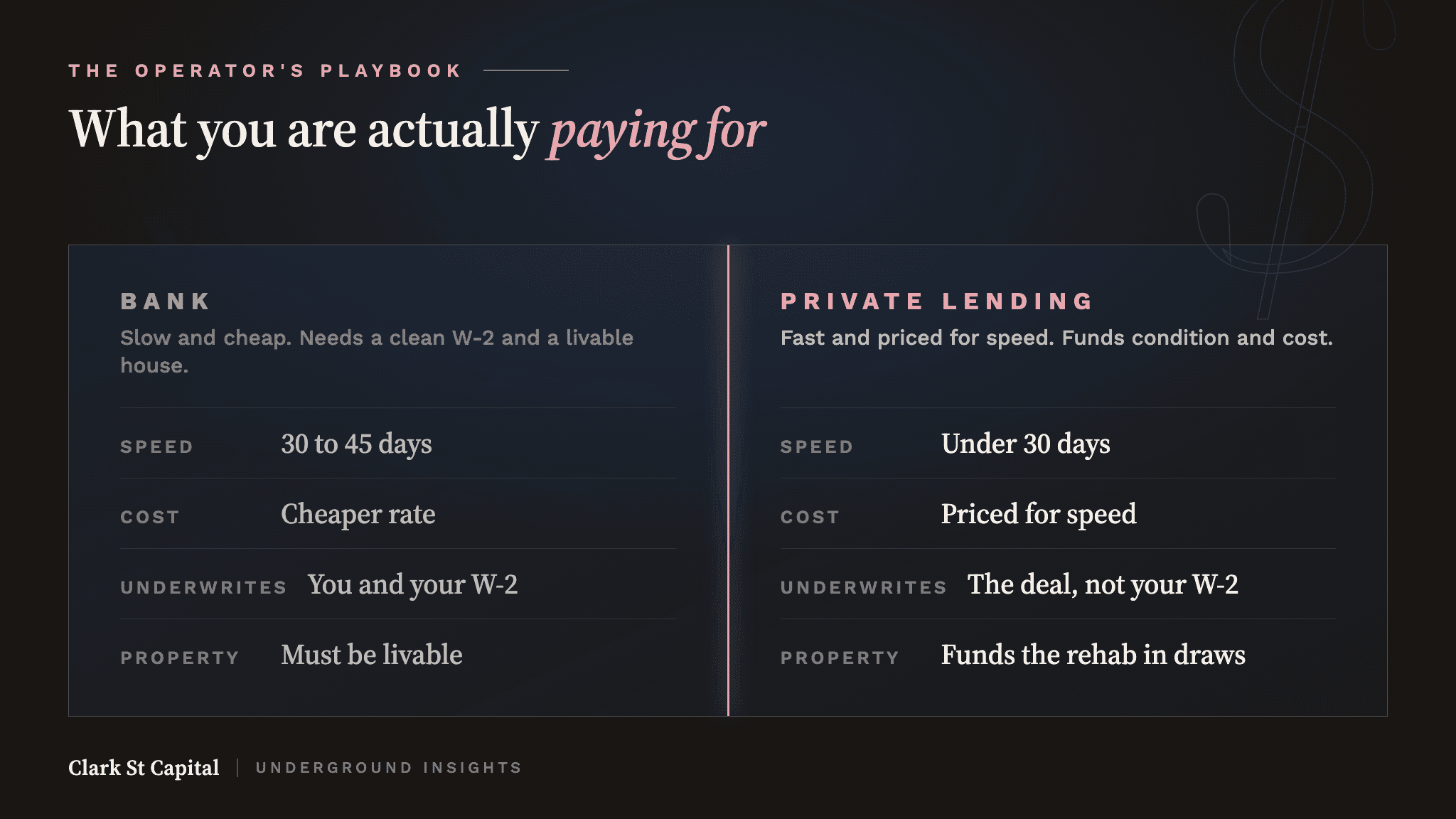
The bridge is built for speed and construction. It closes fast, it releases rehab money in stages and it's short term. It's not designed to sit on a rented property for 30 years and you don't want it to.
The DSCR loan is built for the long-term. It's slower to close. It's based on the finished property and the income it throws off. It's long term.
Trying to use one loan for both jobs is why BRRRR deals go sideways. You need the right tool for each half.
The bridge: buy and rehab (this is our part)
This is the loan Clark St Lending writes. We fund the front half of the BRRRR.
The terms on our bridge:
- Up to $2M per deal.
- Up to 90% of the acquisition price and 100% of the rehab.
- Construction draws funded in 24 hours or less.
- Closed in under 30 days.
- A 12-month, interest-only term.
That 90-and-100 number is loan-to-cost. It's measured against what the project costs you, not against what it'll be worth when it's finished. Those are two different targets and borrowers mix them up constantly.
Loan-to-cost is the buy-and-rehab math on the front end.
Loan-to-value is the refinance math on the back end.
Don't let a lender blur them and don't blur them yourself when you're modeling a deal.
One more piece of our structure that matters for a BRRRR: we hold six months of interest in escrow as a reserve.
During the rehab, before a tenant is in and paying, that reserve covers your interest. You're not feeding the loan out of pocket while the crew is still working. That's a capital-protection feature for you as much as for our investors.
Our floor to get in the door is a 660 credit score. Above that, the rate is set by your experience, your financial strength and the risk in the specific project. Points are charged at closing. We've done 75-plus of these ourselves in Connecticut and Rhode Island, so we're pricing the deal the way an operator would, not the way a call-center lender would.
The refinance: DSCR out (this is your half and it isn't ours)
Here's where we're transparent about the handoff. The refinance is not a Clark St product (yet). When the property is rehabbed and rented, you refinance into a DSCR loan from a lender who does permanent rental debt.
DSCR stands for Debt Service Coverage Ratio. A DSCR loan doesn't qualify you on your personal income the way a conventional mortgage does. It qualifies the property. The lender looks at the rent the house produces and compares it to the payment on the new loan.
The ratio is the property's net operating income divided by its annual debt service. A ratio of 1.0 means the rent exactly covers the payment. Lenders want a cushion above that, so the income comfortably clears the loan. As of the writing of this article, I'm seeing DSCR minimums that range from 1.05 to 1.3, depending on the lender.
The DSCR loan is sized two ways at once. It's capped at a percentage of the new appraised value, its loan-to-value and it has to pass that rent-to-payment test. Both have to work. A high appraisal doesn't help if the rent won't support the payment and strong rent doesn't help if the appraisal comes in low.
The math, walked through one deal
Numbers make this concrete. This is an illustrative Connecticut deal, not a specific one.
Say you find a house at $300,000 that needs $80,000 of work. Total project cost is $380,000. Finished, it appraises at $500,000 and rents for $3,500/month. That's enough to cover a permanent payment with room to spare.
The bridge (aka Fix and Flip): up to 90% of the $300,000 purchase is $270,000, plus 100% of the $80,000 rehab. That's a $350,000 bridge. You bring roughly $30,000 to the purchase, plus closing costs. Draws fund your rehab in 24 hours as the work gets done.
You finish the job. You rent it for $3,500. Now you refinance.
The DSCR lender sizes the new loan against the $500,000 finished value. At 75% of that value, the new loan is $375,000. That $375,000 pays off the $350,000 bridge and returns the roughly $25,000 you put in. For an 8% DSCR loan, you're going to pay about $2,750 per month plus insurance and property taxes.
Your capital is back in your pocket. The house is on long-term debt. You go find the next one. That's the R that makes the whole strategy work and it only happens because the finished value and the rent were high enough to support a refinance that clears the bridge.
What has to be true for the exit to work
The bridge is the easy half to plan. The refinance is where BRRRR deals get bumpy, so underwrite the exit before you close on the buy.
Three things have to be true.
The finished value has to come in high enough that a refinance at loan-to-value clears the bridge. The rent has to be strong enough to pass the DSCR test. Your credit has to hold at 660-plus through the whole project, because the takeout lender will pull it again.
If those three don't pencil before you buy, you don't have a BRRRR. You have a flip that you should sell at the end or a deal you should pass on. We'll tell you that straight when you submit it. We'd rather fund a deal that recycles cleanly than watch you get stuck holding a rental you can't refinance.
Bring us the front half
We fund the bridge: the buy and the rehab, fast, on a 12-month term built to hand off to a clean DSCR refinance. We'll be honest with you about whether the exit actually works before you commit.
Submit your deal at clarkst.com/submit-your-deal and we'll underwrite the whole path with you, not just the piece we fund.
Prefer to listen first? We break down deals like this on the Real Estate Underground podcast, unscripted, every Tuesday.
About Ed Mathews
Ed is the founder of Clark St Capital, Clark St Homes and Elevista. He started investing in 2011 after analyzing deal after deal and making zero offers, until a mentor handed him a pen and made him sign his first contract. Since then, Clark St has operated across single-family, multifamily and land development, with Ed also invested as a limited partner in funds and large multifamily projects. Ed also spent more than two decades in Silicon Valley building systems for global companies. He hosts the Real Estate Underground podcast, with new episodes every Tuesday at 12pm.