TL;DR
- A DSCR loan qualifies a rental property on the income the property produces, not on your personal financials.
- DSCR stands for debt service coverage ratio: net operating income divided by annual debt service. Above 1.0 means the rent covers the loan payment with room to spare.
- Buy-and-hold investors use DSCR loans because they scale. Your W-2 and your DTI stop being the drag on how many doors you can own.
- On a BRRRR or a flip you plan to keep, the DSCR loan is the exit, not the entry. You buy and renovate with short-term money, then refinance into a DSCR loan once the property rents.
- At Clark St we fund the short-term side of that story. The DSCR loan is the takeout you graduate into after the work is done.
- We will be offering DSCR loans in the near future.
What a DSCR loan actually is
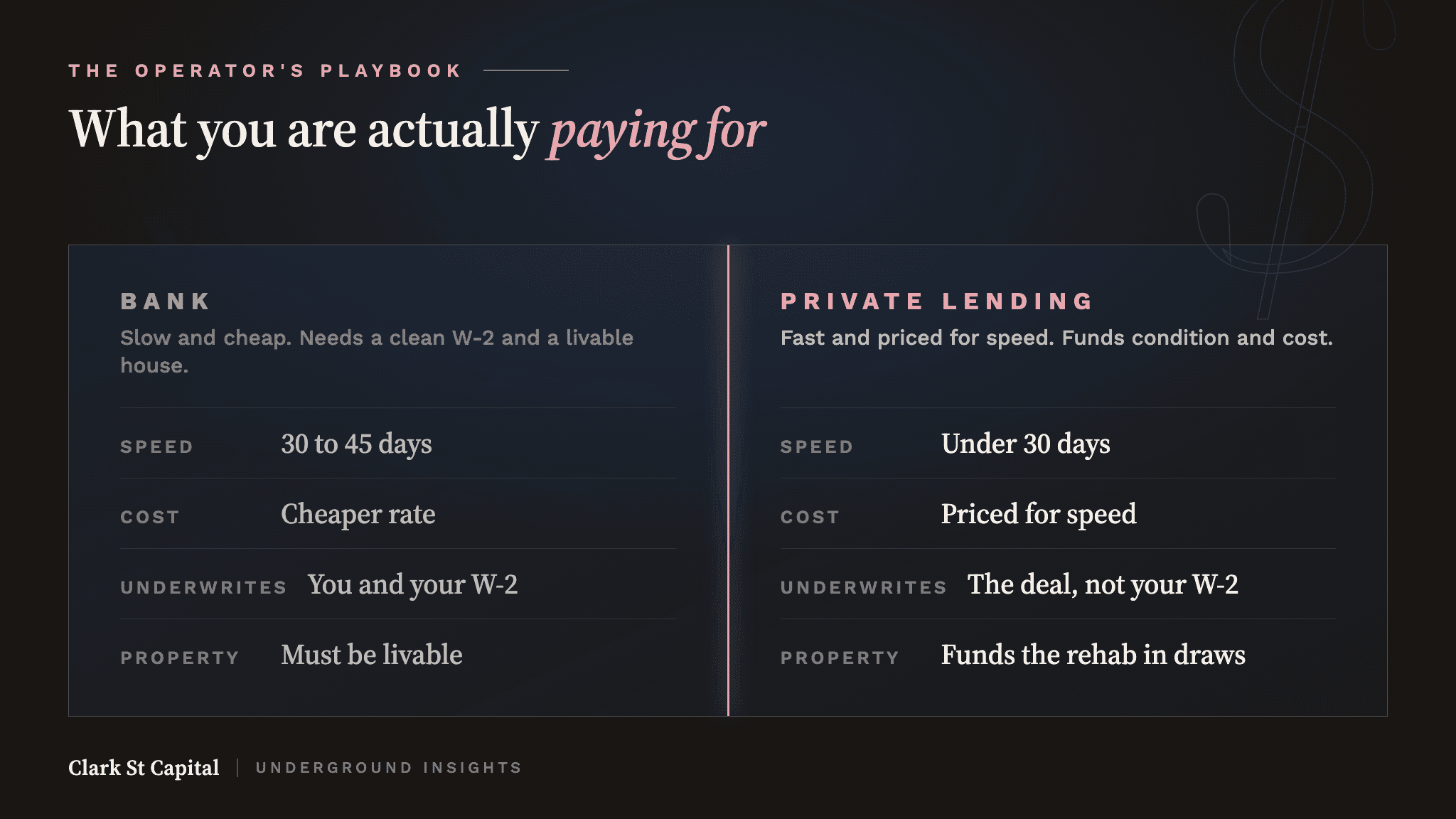
A DSCR loan qualifies your rental on the rent it produces, not on your W-2, your tax returns, or your personal debt-to-income ratio.
That one difference is the everything. A conventional mortgage lender underwrites you. They pull your tax returns, add up your personal debts and decide how much house your income can carry. A DSCR lender underwrites the property. They ask a simpler question: does this building pay for itself?
For a full-time investor, that distinction is the difference between two rentals and twenty. Conventional lenders count every mortgage you already hold, against you. A DSCR lender doesn't care how many doors you own, as long as each one covers its own loan.
How the DSCR ratio works
A DSCR loan calculation is simple arithmetic.
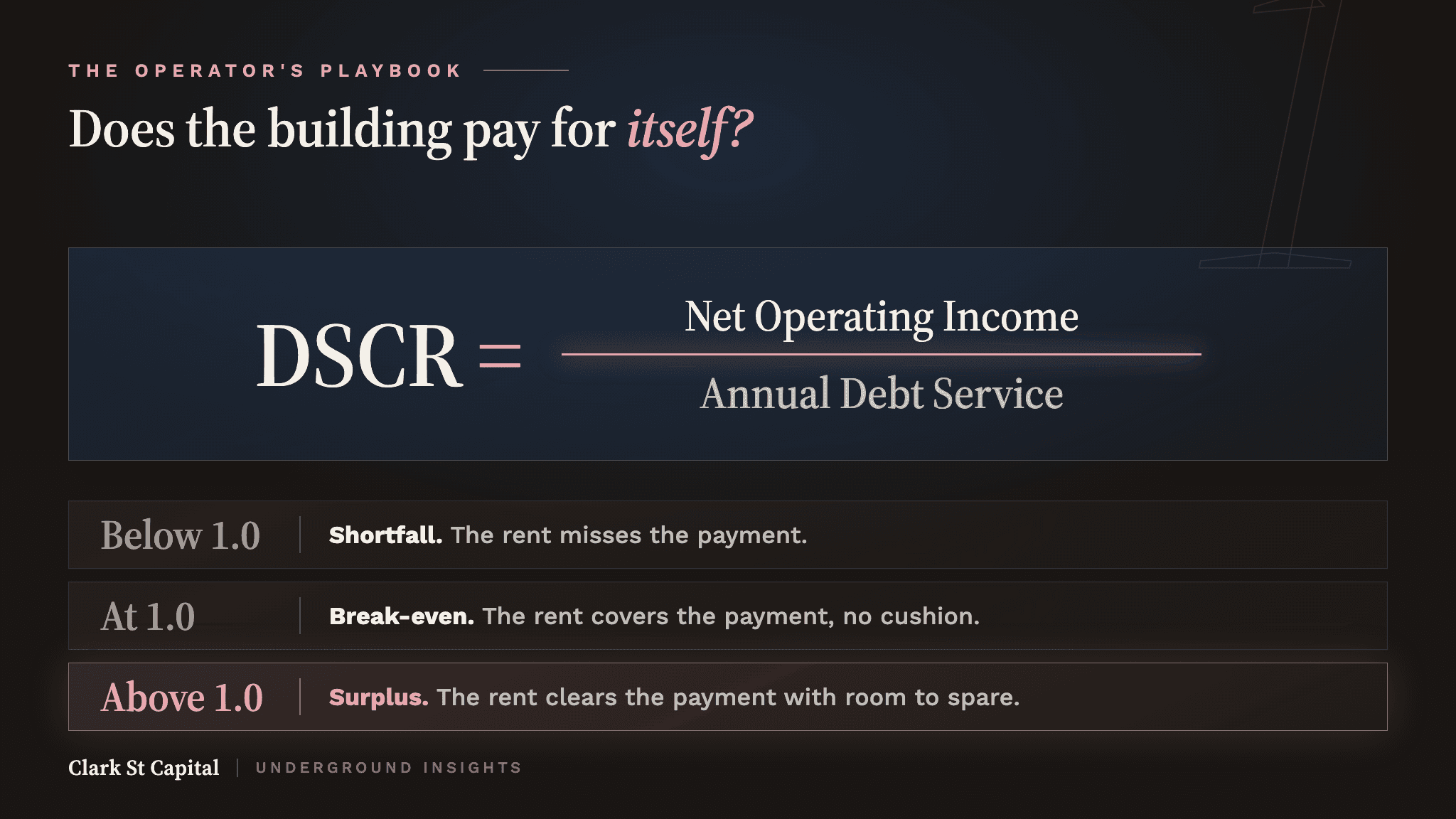
Take the property's net operating income, which is the annual rent minus the operating expenses (taxes, insurance, management, maintenance, vacancy). Divide that by the annual debt service, which is the total of the mortgage payments for the year.
Net operating income divided by annual debt service. That's the ratio.
Run a hypothetical. Say a rental brings in $30,000 a year after expenses and the annual loan payments come to $24,000. Thirty divided by twenty-four is 1.25. The property earns 25 cents of surplus for every dollar of debt it carries.
Now read the three cases:
- Below 1.0: the rent doesn't cover the payment. The property loses money before you touch it.
- At 1.0: break-even. The rent covers the payment exactly, with no cushion.
- Above 1.0: surplus. The higher the number, the more margin the property throws off.
Lenders want a cushion above break-even before they fund. The exact minimum varies by lender and by loan, but most set the floor above 1.0 rather than at it. As of the writing of this article, I'm seeing DSCR minimums that range from 1.05 to 1.3, depending on the lender. The point for a borrower is the same either way: a property that barely breaks even is a harder loan than a property that clears the payment with room left over.
Why buy-and-hold investors use it
Two reasons and they both come down to scale.
First, no personal income documentation. If you're a flipper or a full-time investor, your tax returns are a mess of write-offs and your debt-to-income ratio looks terrible on paper, even when the portfolio is healthy.
A DSCR loan sidesteps that. The property qualifies on its own rent, so a strong deal doesn't get killed by a complicated personal return.
Second, it doesn't cap you. Conventional financing tends to stall out after a handful of mortgages because every new loan impacts your DTI. DSCR loans stack. Each property stands on its own. The tenth deal is underwritten the same way as the first.
The tradeoff is real. The lender looks at the property instead of you personally. DSCR loans generally carry different pricing than an owner-occupied conventional mortgage. You're buying flexibility and speed and that costs something.
For an investor building a portfolio, the math usually still works, because the alternative is not being able to borrow at all.
Where it fits after a flip
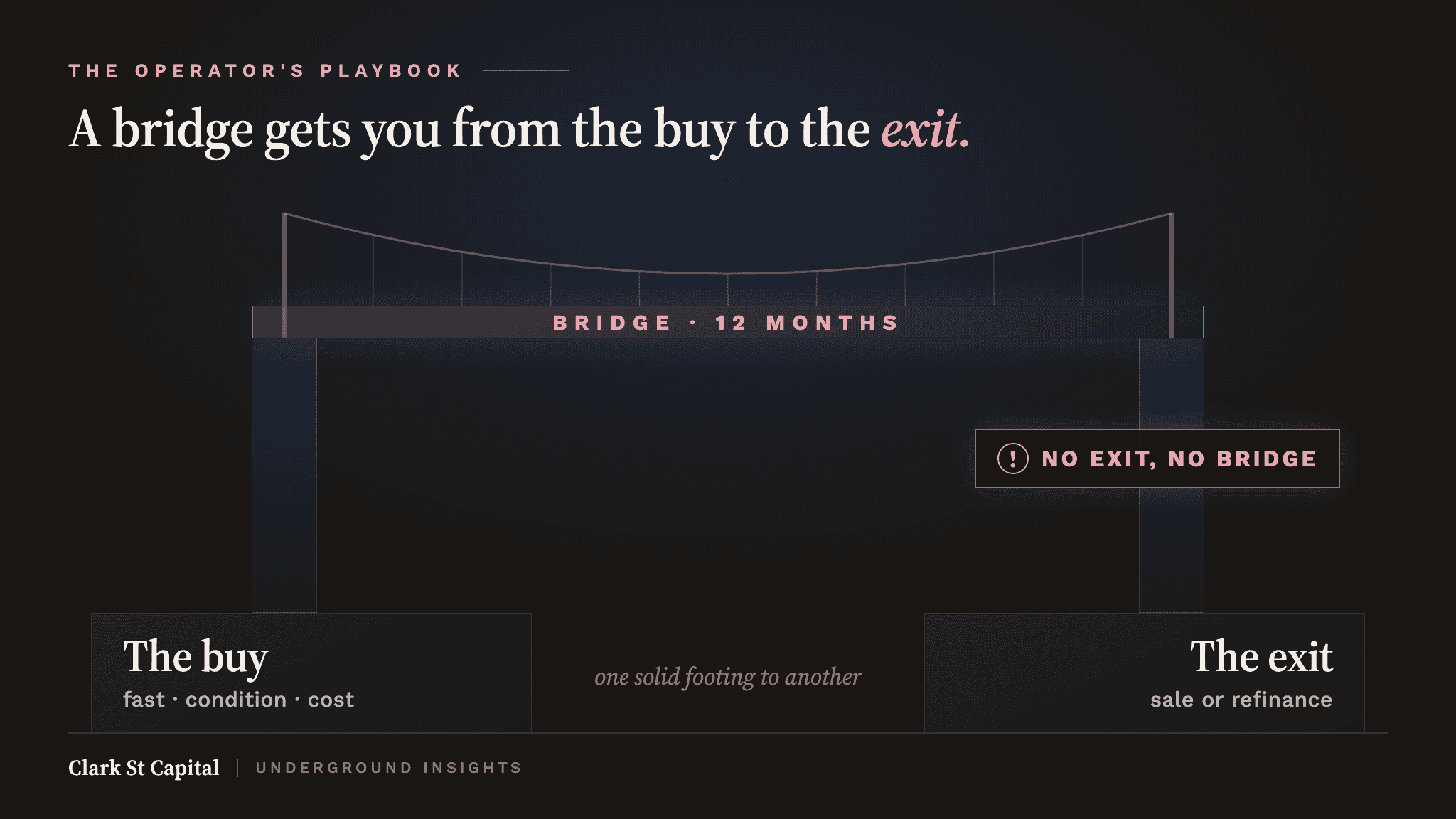
Here is the part most new investors miss. On a BRRRR (buy, rehab, rent, refinance, repeat), the DSCR loan is not how you buy the house. It is how you refinance out.
The acquisition loan and the permanent loan are two different products, built for two different objectives.
You cannot get a DSCR loan on a house that isn't rented yet. A property mid-renovation has no net operating income, so there is nothing for the ratio to measure. That's why the capital path runs in two stages:
- Short-term money to buy and renovate.
- A DSCR loan to refinance once the property is finished and leased.
Buy and fix with a bridge loan. Rent it. Then refinance into a DSCR loan, pull your capital back out and go do it again. The DSCR loan is the takeout at the end, not the funding at the start.
Where Clark St sits in that path
We're the front half of that story, not the back half (yet).
Clark St Lending funds the acquisition and the rehab on Connecticut single-family and small multifamily deals: up to $2M per deal, up to 90% of the purchase price and 100% of the rehab, with construction draws funded in 24 hours or less and closings in under 30 days. That's 12-month money, structured as a bridge you refinance out of once the work is done.
The DSCR loan is what you refinance into. We're not a DSCR lender and we will tell you so plainly. We're the operator-run capital that gets the property bought, renovated and rented, so that a DSCR loan is even possible. Our loans (short-term) are the bridge to the DSCR (long-term) loan.
If you're mapping out the financing on your next Connecticut flip or BRRRR and want to understand how the bridge side works before you need it, take a look at clarkst.com/borrow.
About Ed Mathews
Ed is the founder of Clark St Capital, Clark St Homes and Elevista. He started investing in 2011 after analyzing deal after deal and making zero offers, until a mentor handed him a pen and made him sign his first contract. Since then, Clark St has operated across single-family, multifamily and land development, with Ed also invested as a limited partner in funds and large multifamily projects. Ed also spent more than two decades in Silicon Valley building systems for global companies. He hosts the Real Estate Underground podcast, with new episodes every Tuesday at 12pm.