An IRA that buys into a leveraged apartment syndication can owe tax on its share of the rent, even though the IRA never signed a loan. That tax is paid from the retirement account itself, on a Form 990-T. Lend the IRA's money to yourself or your child and the IRS treats the entire balance as distributed to you.
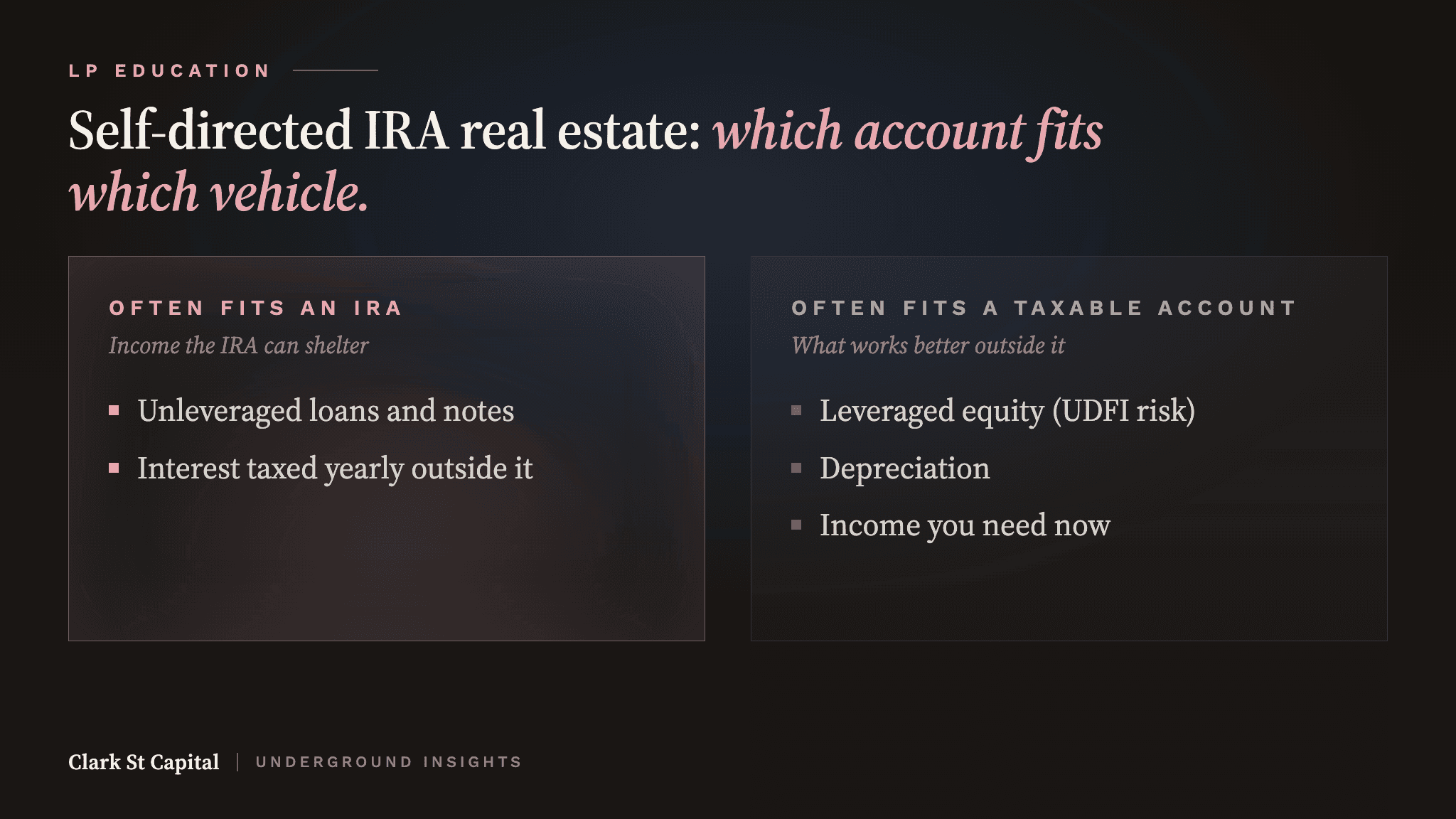
A self-directed IRA can own rentals, mortgage notes, syndication interests and shares of a debt fund. The tax result turns on borrowing. Leveraged real estate, including a partnership's mortgage, can produce unrelated debt-financed income inside the IRA, while unleveraged lending generally earns interest the IRA keeps. Which account should hold each one comes down to four factors.
The rules a self-directed IRA follows
The tax code has no separate category for a self-directed IRA. It's a traditional or Roth IRA held at a custodian that allows alternative assets. Contributions and rollovers follow IRS Publication 590-A.
The IRA owns every investment. That's why the prohibited transaction rules exist. Disqualified persons include you, your spouse, your parents and grandparents, your children and grandchildren and their spouses, and any company you or they own 50% or more of. The IRA can't lend to you, buy property for your or your family's personal use or be pledged as security for your loan.
Generally, if you or your beneficiary engage in a prohibited transaction, the IRA ends as of the first day of that year. The IRS treats the full balance as distributed to you at fair market value.
The custodian holds the assets and signs documents in the IRA's name. It doesn't vet the deal. The SEC, NASAA and FINRA investor alert states that you have "sole responsibility for evaluating and understanding the investments in the account."
How borrowing creates tax inside an IRA
IRS Publication 598 lists IRAs among the accounts subject to tax on unrelated business income.
Publication 598 excludes interest, dividends and similar investment income from UBTI. The exclusion stops where borrowing starts. Income from debt-financed property, called unrelated debt-financed income (UDFI), is taxable in proportion to the debt.
In an IRS example, a building earns $20,000 of rent and carries a 50% debt-to-basis percentage. Half the rent, $10,000, goes into the UBTI calculation, along with half of the related deductions.
Partnership debt counts. When an exempt investor buys into a partnership, its share of the partnership's mortgage is treated as its own acquisition debt. A limited partner interest in a leveraged syndication can produce UDFI even though the IRA signed no loan.
IRAs don't get the real estate exception. Publication 598 exempts real property debt held by qualified retirement plans under section 401(a) and certain educational organizations. IRAs aren't on that list.
If an IRA has $1,000 or more of gross unrelated business income in a year, a Form 990-T is required. The tax is paid from the IRA, which shrinks the account.
Lending works differently. An IRA that owns a note, or a share of a fund that makes loans with investors' money and doesn't borrow, receives interest. Interest generally falls under the exclusion. A fund that borrows against its loan book is a different case, because the borrowing can turn part of that interest into debt-financed income.
Where real estate fits in your financial journey
Four factors decide which account should hold which vehicle.
How the income is taxed outside the IRA. Interest from a loan or debt fund is taxed as ordinary income every year in a taxable account. Sheltering it in an IRA removes that annual drag. Leveraged equity often throws off depreciation that offsets its own income. Inside an IRA, depreciation only offsets debt-financed income, so most of that benefit is lost.
Whether the investment uses leverage. Leveraged equity inside an IRA invites UDFI and a Form 990-T. Unleveraged lending generally doesn't. A taxable account has no UDFI concept at all.
When you need the cash. Income paid to an IRA stays in the IRA. If you're counting on distributions to cover living costs before retirement, a taxable account delivers them. An IRA doesn't, without early withdrawal rules coming into play.
How close you are to required minimum distributions. Traditional IRA owners generally must begin required minimum distributions at age 73, or 75 if you were born in 1960 or later. An illiquid investment still counts toward the balance the RMD is figured on. Under the IRS RMD FAQs, you can take the total from one or more of your IRAs, which helps only if another IRA holds cash. Roth IRAs have no RMDs while the owner is alive.
A simple way to apply this:
- List each real estate investment you're weighing and note whether it borrows, at the property or the fund level.
- Mark whether its return is mostly interest or mostly equity growth with depreciation.
- Check its lockup against the year your required minimum distributions begin and against any cash you expect to need before the lockup ends.
- Leveraged equity, depreciation and near-term cash needs point to the taxable account. Unleveraged interest with a lockup you can live with points to the IRA.
Hypothetical example. An investor at 45 with a large rollover IRA and a strong salary has little need for current income. Unleveraged interest fits the IRA. A leveraged apartment syndication, whose depreciation can offset income on a taxable return, fits the taxable account. Reverse the placement and the investor pays tax on interest each year and may owe UBIT inside the IRA. For a broader comparison of the two vehicles, see debt fund vs. real estate syndication.
Questions to ask any sponsor or fund before investing IRA money
- Does the fund or property borrow, including credit lines or loans against the loan book? How much, and who holds the debt?
- Has the fund's tax advisor addressed UBTI and UDFI for IRA investors in writing?
- Will the IRA receive a K-1 or a 1099? If a K-1, will it report unrelated business income?
- Does any income come from sources other than interest or rent, such as fees or operating a business?
- What's the lockup, and how are withdrawals or redemptions handled?
- How will the investment be valued each year so the custodian can report fair market value?
- Which self-directed IRA custodians has the sponsor already processed subscriptions with?
For the rest of the diligence list, see how to compare real estate debt funds and what a real estate debt fund is.
The rules above are general. Your own tax situation belongs with your CPA before any IRA money moves.
FAQ
Can a self-directed IRA own real estate?
Yes. It can hold property, a mortgage note or an interest in a private real estate fund, if the custodian permits it and no disqualified person benefits personally.
Can you use a self-directed IRA to buy a house you live in?
No. Buying property for present or future personal use with IRA funds is a prohibited transaction.
Do self-directed IRAs pay tax?
Usually not while the money stays inside. Traditional IRA withdrawals are generally taxed as income and qualified Roth distributions aren't (IRS Publication 590-B). The exception is unrelated business income, including UDFI from leveraged property.
Does a debt fund create UBIT in an IRA?
Interest is generally excluded from UBTI. If the fund borrows to make its loans, or earns fees beyond interest, part of its income can become taxable inside the IRA.
Always seek the advice and counsel of a qualified legal, financial, and/or accounting professional before making any decisions of this importance.
About Ed Mathews
Ed is the President of Clark St Capital. He started investing in 2011 after analyzing deal after deal and making zero offers, until a mentor handed him a pen and made him sign his first contract. Since then, Clark St has operated across single-family, multifamily and land development, with Ed also invested as a limited partner in funds and large multifamily projects. Ed also spent more than two decades in Silicon Valley building systems for global companies. He hosts the Real Estate Underground podcast, with new episodes every Tuesday at 12pm.