An investor asked me last month how often the fund pays. Monthly, he assumed, because that's how he'd been shopping for it. He'd typed "monthly income investments" into a search bar and lined up everything that promised a check every 30 days.
I told him he was optimizing the wrong variable.
The question isn't how often income shows up. It's whether it shows up when it's supposed to, and what stands behind it if a deal goes sideways. A fund that forces itself to cut a check every month often makes worse decisions on cash and collateral to hit that calendar. Frequency is the feature people shop for. Reliability is the one that protects them.
TL;DR
- "Monthly income investments" is a search built around the wrong variable. How often a fund pays is not the same as whether you can count on it.
- A disciplined real estate income fund often distributes quarterly, because forcing a monthly payout pressures a manager to keep cash idle or move on collateral before a deal is ready.
- What you actually want is income that arrives when promised, backed by a specific property with the owner's equity sitting underneath it.
- On this kind of fund the minimum is 100,000 dollars, the target is 11 percent, it's a target and never a guarantee, and distributions are paid quarterly on a 12-month term.
- The manager invests alongside investors on the same terms, with no promote and no spread skimmed off the top.
Why "how often it pays" became the question
It's an easy trap, and the search results feed it. Type "monthly income" into anything financial and you get a wall of products sorted by payout frequency. So the busy professional does the natural thing. He treats a monthly check as the mark of a good income investment and screens everything else out.
Here's the problem. Payout frequency tells you almost nothing about whether the income is safe, whether it will still be there in a hard year, or what happens to your principal if a borrower stumbles. It's a calendar setting. You can pay monthly on a portfolio that's one bad quarter from a cut, and you can pay quarterly on a loan book that's protected six ways. The frequency doesn't tell them apart.
So the honest first move is to stop screening on cadence. It's the easiest number to compare and the least useful one to trust.
What forcing a monthly payout does to a manager
This is the part most investors never see, so it's worth walking through.
To pay you every 30 days, a manager needs cash ready every 30 days. There are only two ways to get it. Hold a bigger pile of uninvested cash sitting in the fund earning nothing, which drags down the return you were paid to receive. Or pull money out of loans and collateral faster than the deals are actually ready to give it up.
Real estate loans don't produce cash on a 30-day rhythm. A borrower pays interest, refinances, or sells on the project's timeline, not the calendar's. Push a monthly distribution schedule on top of that and the manager is either sitting on idle cash or making moves on collateral to feed the payout clock instead of the deal.
Quarterly takes that pressure off. It gives the manager room to let a loan season, to hold a reserve, and to make decisions about collateral on the merits of the deal instead of a deadline three weeks out. That discipline isn't a convenience for us. It's what protects your principal.
Ed broke down how a debt strategy actually earns its yield, line by line, in a recent piece and on Real Estate Underground. The short version: the return comes from borrower interest and points, not from squeezing collateral to hit a calendar.
The question that actually matters
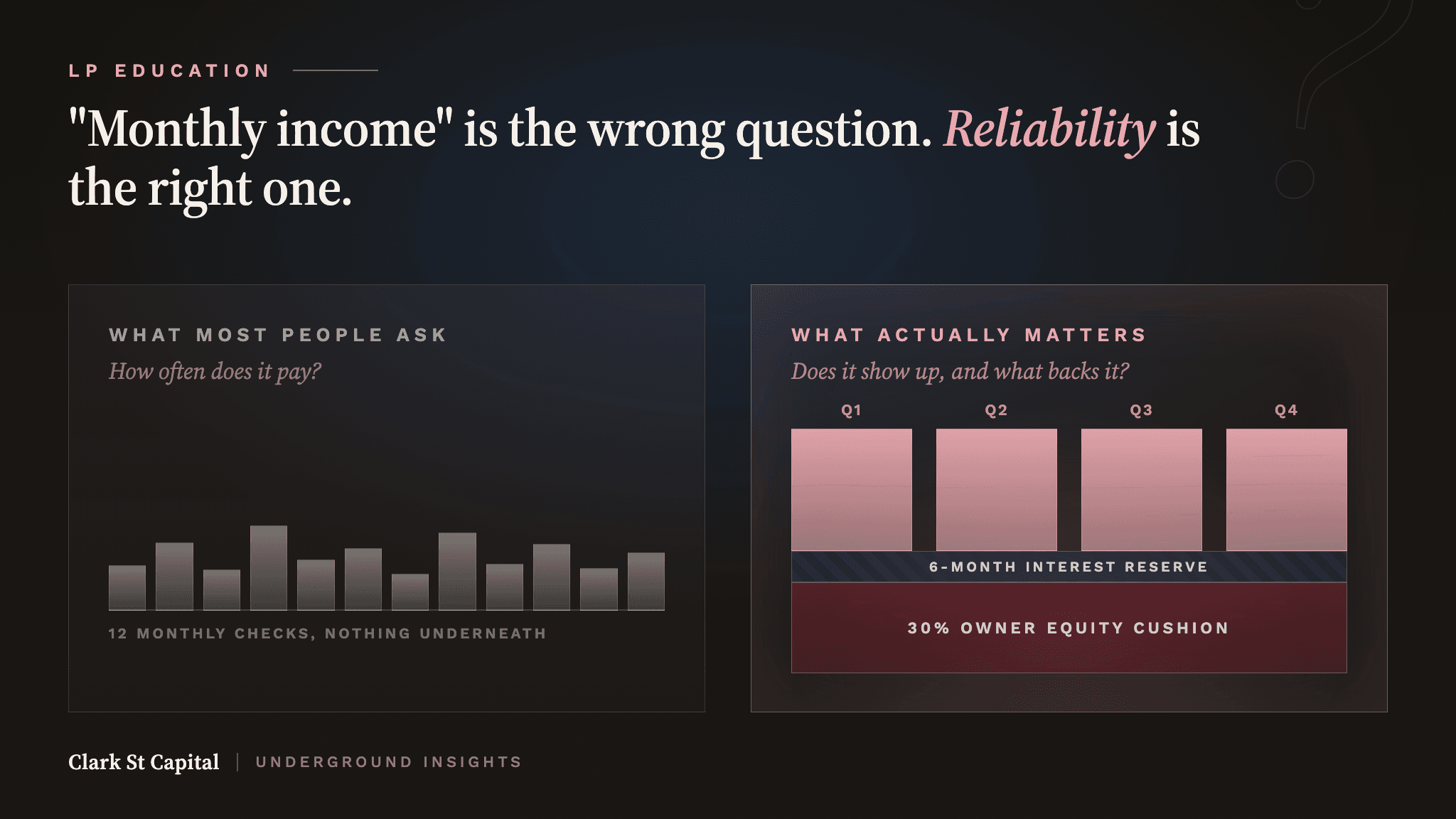
Replace "how often does it pay" with two better questions. Does the income show up when promised? And what's underneath it if a deal goes wrong?
On the loans behind a fund like this, the answers are structural, not hopeful. The fund lends in first position, so if a project falls short and the property sells, the loan gets paid before the owner sees a dollar. The loan is capped at 70 percent of the property's after-repair value, which means the owner's roughly 30 percent equity sits under your money and takes the first loss. The property has to fall through that entire cushion before it touches your principal.
There's one more piece, and it's the one a monthly schedule would quietly burn. At closing we hold six months of the borrower's interest in escrow, a reserve. If an operator hits a rough patch mid-project, that reserve keeps your distribution coming while we work the problem with them. A fund straining to pay monthly doesn't get to build a buffer like that. It spends it.
That's reliability. Not a check that arrives fast, a check that arrives protected.
What quarterly actually costs you
Name the tradeoff plainly, because there is one.
If you need a payment on the first of every month to cover a fixed bill, a quarterly fund isn't your tool, and I'd tell you that to your face. That's a real need and it deserves a real answer, which might be a different instrument entirely.
But for most people shopping "monthly income," the monthly part is a habit, not a requirement. The money you don't receive in month one and month two isn't gone. It's working, it's protected by the cushion under every loan, and it's paid to you a few weeks later. You give up nothing that compounds. You trade a calendar preference for a manager who isn't forced into worse decisions to satisfy it.
Steady income you can count on across cycles, from a protected loan book, beats a faster check from a fund straining to make its own deadline. That's the whole reframe. Stop asking how often. Start asking how reliably, and what's underneath it.
The takeaway
The investor who wanted monthly wasn't wrong to want income. He was measuring it with the wrong ruler.
What he actually wanted was money he could count on, backed by something real, that showed up when it was supposed to. Cadence couldn't tell him whether he had that. Structure could. On this kind of fund the target is 11 percent, it's a target and never a guarantee, distributions are paid quarterly on a 12-month term, and the manager's capital sits in the same loans on the same terms.
If you want the operator's read on how income like this behaves through a real cycle, told through actual deals instead of projections, that's what our newsletter, Underground Insights, covers every month. It isn't tips and tricks. It's real deals and the real lessons of putting capital to work and protecting it.
Sign up at clarkst.com/newsletter.
Prefer to listen? Subscribe to the Real Estate Underground podcast for the same conversations, unscripted.
About Ed Mathews
Ed is the founder of Clark St Capital, Clark St Homes and Elevista. He started investing in 2011 after analyzing deal after deal and making zero offers, until a mentor handed him a pen and made him sign his first contract. Since then, Clark St has operated across single-family, multifamily and land development, with Ed also invested as a limited partner in funds and large multifamily projects. Ed also spent more than two decades in Silicon Valley building systems for global companies. He hosts the Real Estate Underground podcast, with new episodes every Tuesday at 12pm.